In academic writing, the conclusion paragraph is often treated as an afterthought, written quickly once the main argument feels complete. This approach frequently leads to weak endings that summarise content without demonstrating intellectual control.
Universities do not assess conclusions as decorative endings. Instead, the conclusion paragraph is evaluated as a structural component that demonstrates synthesis, coherence, and understanding of the assignment’s purpose. Knowing how a conclusion paragraph is structured is therefore essential for strong academic performance.
The Academic Purpose of a Conclusion Paragraph
A conclusion paragraph exists to consolidate meaning rather than to restate information. Its role is to bring together the central argument, key analytical threads, and overall implications of the essay in a way that confirms intellectual closure.
From an examiner’s perspective, a conclusion signals whether the writer understands how individual sections of the essay function collectively. A well-structured conclusion demonstrates control over the argument rather than dependence on repetition.
This distinction explains why conclusions are judged differently from summaries.
Key academic rule: A conclusion paragraph synthesises arguments; it does not merely repeat them.
Core Components of an Effective Conclusion Paragraph
Although conclusions vary by discipline and assignment type, strong academic conclusions follow a recognisable internal structure. This structure supports clarity and prevents common mistakes such as introducing new ideas or drifting into reflection.
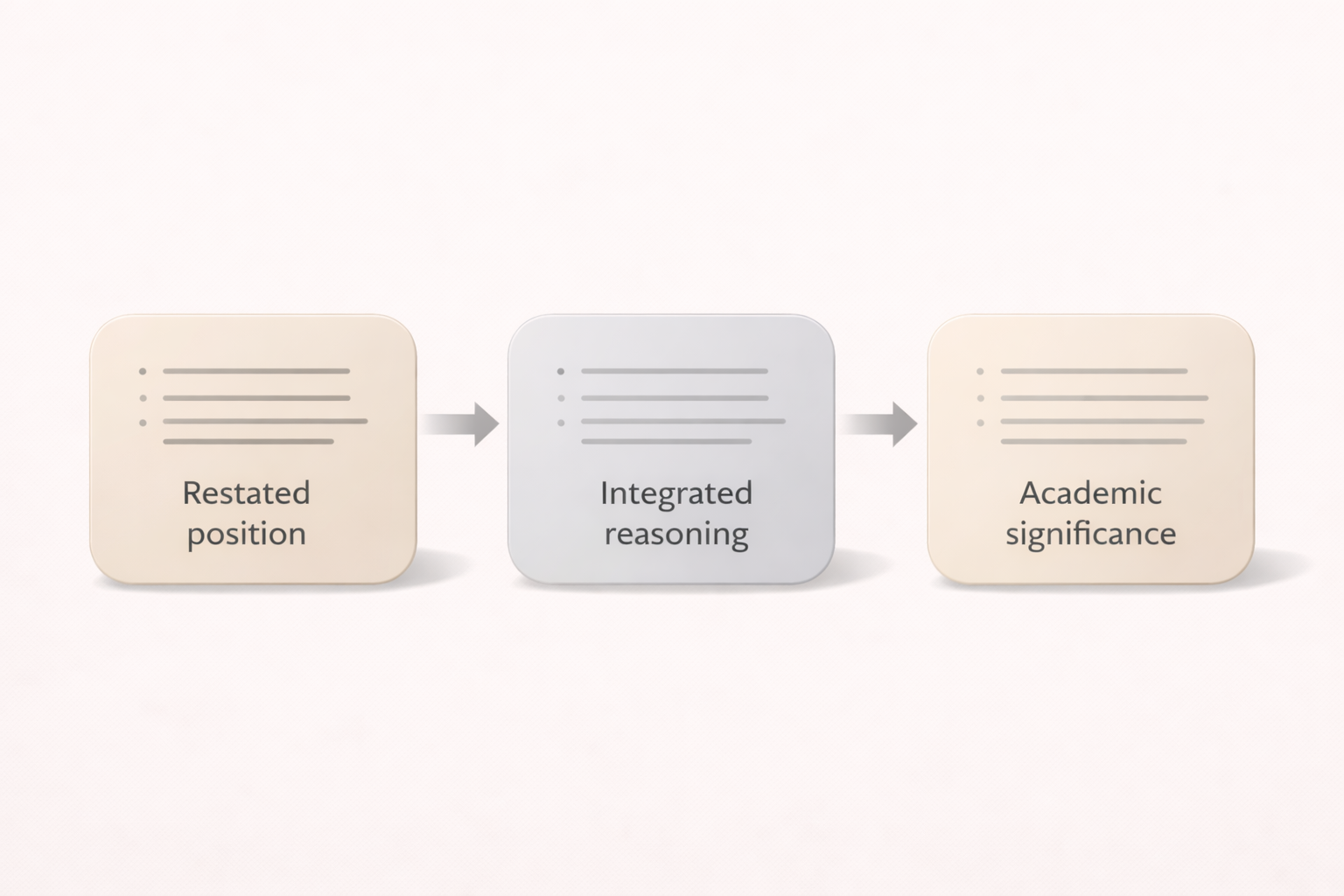
The conclusion paragraph typically consists of three interrelated components: restated position, integrated reasoning, and broader significance. These components work together rather than appearing as isolated sentences.
Understanding each component individually helps students construct conclusions with purpose and coherence.
Restating the Central Position
The first structural element of a conclusion paragraph is a refined restatement of the essay’s central position. This does not mean copying the introduction or thesis statement verbatim.
Instead, the central position should be rearticulated in light of the analysis that has taken place. The wording reflects progression, showing how the argument has been supported or clarified through evidence.
This opening anchors the conclusion and signals closure.
Integrating Key Analytical Threads
After restating the position, the conclusion paragraph integrates the main analytical strands developed in the body. This integration demonstrates synthesis rather than listing.
Effective integration shows relationships between ideas, such as how evidence, theory, or examples collectively support the argument. The emphasis is on connection rather than enumeration.
Examiners look for this integration as evidence of higher-order thinking.
Establishing Broader Significance
The final structural component of a conclusion paragraph addresses significance. This may involve implications, relevance to the field, or confirmation of why the argument matters within the academic context.
Significance does not mean speculation or introducing new material. It means drawing meaning from what has already been established.
This element gives the conclusion intellectual weight and prevents abrupt endings.
Logical Flow Within the Conclusion Paragraph
A strong conclusion paragraph follows a deliberate logical progression. It moves from reaffirmation, to integration, to implication without abrupt transitions.
This progression mirrors the overall essay structure but operates at a condensed level. Each sentence builds on the previous one, reinforcing coherence.
When this flow is absent, conclusions often feel disjointed or incomplete.
Length and Proportion in Conclusion Paragraphs
Conclusion paragraphs are typically concise but not minimal. Their length should reflect the complexity of the essay rather than a fixed word count.
As a general academic principle, conclusions should be proportionate to the overall length of the essay. Very short conclusions often signal underdevelopment, while overly long conclusions risk repetition.
Balance is achieved through focused synthesis rather than expansion.
Structural Differences Across Assignment Types
While the core structure of a conclusion paragraph remains consistent, its emphasis may shift depending on the assignment type. Analytical essays prioritise argument integration, while reports may emphasise outcomes or recommendations.
Research-based assignments often include limitations or future considerations within the significance component, provided these are grounded in the analysis.
Understanding assignment context helps refine conclusion structure without altering its core function.
| Assignment Type | Primary Structural Emphasis | Common Examiner Expectation |
|---|---|---|
| Analytical essay | Synthesis of argument | Clear demonstration of reasoning |
| Research report | Implications and outcomes | Link between findings and objectives |
| Critical review | Evaluative integration | Judgement supported by analysis |
This variation affects emphasis but not foundational structure.
Common Structural Errors in Conclusion Paragraphs
Many conclusion paragraphs fail not because of weak language, but because of structural misunderstandings. These errors are among the most frequently penalised in academic marking.
- Introducing new arguments or evidence
- Repeating body paragraphs sentence by sentence
- Ending abruptly without synthesis
Each of these errors disrupts academic coherence and signals weak structural control.
Examiner warning: New ideas introduced in the conclusion are typically ignored or penalised.
Using Transitions Effectively in Conclusions
Transitions in conclusion paragraphs should signal synthesis rather than continuation. Phrases that suggest summation, reinforcement, or consolidation are academically appropriate.
However, excessive signposting can make conclusions sound mechanical. Effective transitions are subtle and integrated into sentence structure.
The goal is clarity without formulaic writing.
Developing Control Over Conclusion Paragraph Structure
Strong conclusion writing develops through practice and revision rather than memorisation. Students should review conclusions alongside introductions to ensure alignment.
Reading examiner feedback and high-scoring exemplars can reveal how structure influences assessment outcomes.
With experience, conclusion structure becomes intuitive rather than forced.
Final Guidance on Conclusion Paragraph Structure
A conclusion paragraph is not a summary, reflection, or afterthought. It is a structured academic component that demonstrates synthesis, coherence, and intellectual closure.
By understanding and applying a clear conclusion paragraph structure, students can strengthen their essays and meet examiner expectations more confidently.
Effective conclusions signal not just an ending, but academic control.

Comments