Pursuing a PhD is not only an intellectual undertaking but also a psychological and strategic one. Beyond research methods and disciplinary knowledge, doctoral success depends on how candidates manage fear, clarity, responsibility, priorities, and decision-making under prolonged uncertainty.
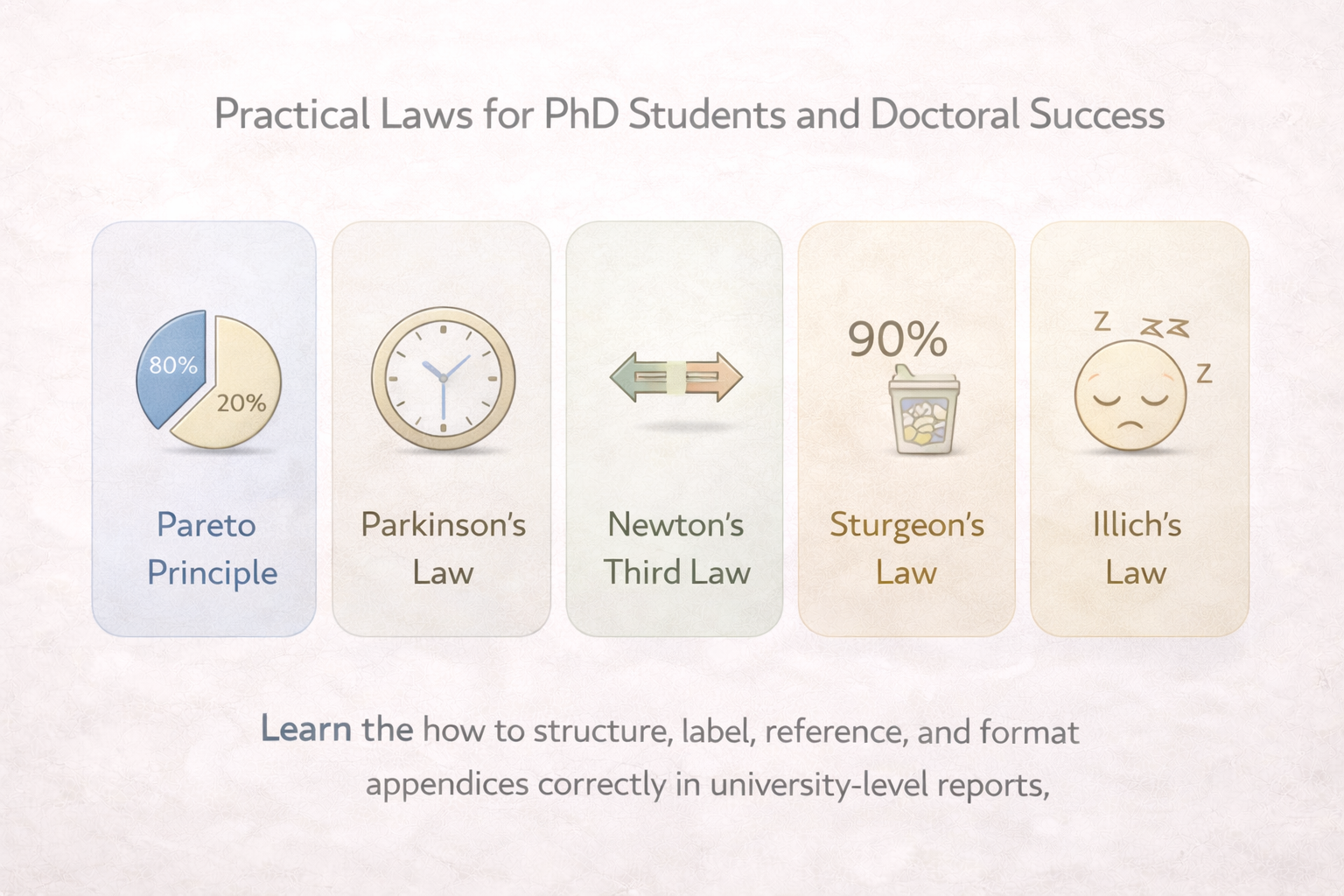
The image presented outlines five so-called “laws” for PhD students. While informal in origin, these principles reflect well-established academic realities that repeatedly surface in doctoral supervision, completion studies, and researcher development literature.
This article translates those five laws into academically grounded guidance, helping doctoral students apply them deliberately and productively throughout their research journey.

Why Informal “Laws” Matter in Doctoral Education
Doctoral education is often described as ambiguous, nonlinear, and emotionally demanding. Unlike structured coursework, PhD study requires sustained independent judgment, tolerance of uncertainty, and self-regulation over several years.
Informal heuristics or “laws” emerge because they capture recurring patterns of difficulty and success. When articulated clearly, these principles help students recognize common traps early and respond strategically rather than reactively.
Doctoral success is shaped as much by decision-making habits as by intellectual ability.
The five laws discussed below provide a practical lens through which PhD students can reflect on their daily research behavior.
Law One: Fear Amplifies Problems Rather Than Preventing Them
The first law highlights a common doctoral experience: the more a student fixates on a feared outcome, the more likely it becomes to interfere with progress. Fear of failure, rejection, or criticism often leads to avoidance, procrastination, or over-preparation.
In doctoral research, avoidance is particularly damaging because progress depends on iterative exposure to uncertainty. Delaying writing, postponing feedback, or avoiding supervision meetings tends to intensify anxiety rather than reduce it.
Productive doctoral work requires engaging with risk in controlled, incremental ways instead of attempting to eliminate it entirely.
Fear does not disappear through avoidance; it diminishes through informed engagement.
Law Two: Clarity Transforms Complex Problems into Solvable Tasks
The second law emphasizes the power of clearly articulated problems. Many PhD students experience cognitive overload because their research questions, objectives, or tasks remain vaguely defined.
Writing a problem down forces conceptual precision. Once a challenge is clearly stated, it can be broken into smaller, manageable components such as literature gaps, methodological steps, or analytical tasks.
Supervisors frequently observe that once a student achieves conceptual clarity, progress accelerates significantly even without additional resources.
- Clear research questions reduce unnecessary reading
- Explicit objectives guide methodological choices
- Written plans expose logical gaps early
Clarity, therefore, is not merely descriptive; it is operationally powerful.
Law Three: Responsibility Is Central to Doctoral Progress
The third law underscores a defining feature of doctoral study: responsibility ultimately rests with the candidate. While supervisors provide guidance, they cannot assume ownership of a student’s research trajectory.
Successful PhD students recognize that waiting passively for direction slows progress. Instead, they proactively identify problems, propose solutions, and seek targeted feedback.
This sense of ownership is closely linked to researcher identity formation, a key milestone in doctoral development.
Doctoral autonomy emerges when responsibility is embraced rather than deferred.
Taking responsibility does not mean working in isolation; it means leading one’s research process deliberately.
Law Four: Intellectual Investment Precedes Material Rewards
The fourth law reflects a long-term reality of academic careers. Prioritizing deep learning, methodological rigor, and intellectual growth often yields delayed but durable rewards.
Doctoral students who focus narrowly on short-term outputs may compromise the depth of their expertise. In contrast, those who invest in understanding theory, methods, and analytical reasoning build transferable scholarly capital.
Academic productivity tends to follow competence rather than precede it.
| Orientation | Typical Outcome |
|---|---|
| Short-term output focus | Surface productivity, limited conceptual depth |
| Long-term intellectual investment | Sustained research competence and adaptability |
Smart academic work prioritizes learning trajectories that compound over time.
Law Five: Strategic Inaction Can Be a Rational Choice
The final law challenges the assumption that constant action is always productive. In doctoral research, premature decisions can lock students into weak designs, unsuitable methods, or poorly framed questions.
Strategic inaction involves pausing deliberately to gather information, reflect, or seek clarification before committing to a course of action.
This principle is particularly relevant during proposal development, theoretical framing, and methodological selection.
Not all progress is visible; sometimes restraint prevents irreversible errors.
Knowing when not to act is a sophisticated research skill developed through experience and reflection.
Integrating the Five Laws into Doctoral Practice
These five laws are not independent rules but interconnected principles that shape doctoral decision-making. Fear management supports clarity; clarity enables responsibility; responsibility encourages intellectual investment; and investment benefits from strategic pacing.
PhD students who consciously apply these principles tend to navigate challenges more effectively and sustain momentum over long research timelines.
Rather than viewing these laws as motivational slogans, doctoral candidates should treat them as practical heuristics for everyday academic judgment.
Using These Principles to Strengthen Your PhD Journey
Doctoral study rarely fails because of a lack of intelligence. More often, difficulties arise from unmanaged fear, unclear thinking, deferred responsibility, misplaced priorities, or rushed decisions.
By internalizing these five laws, PhD students can develop a resilient, reflective, and strategically grounded approach to research that supports both completion and long-term scholarly growth.



Comments