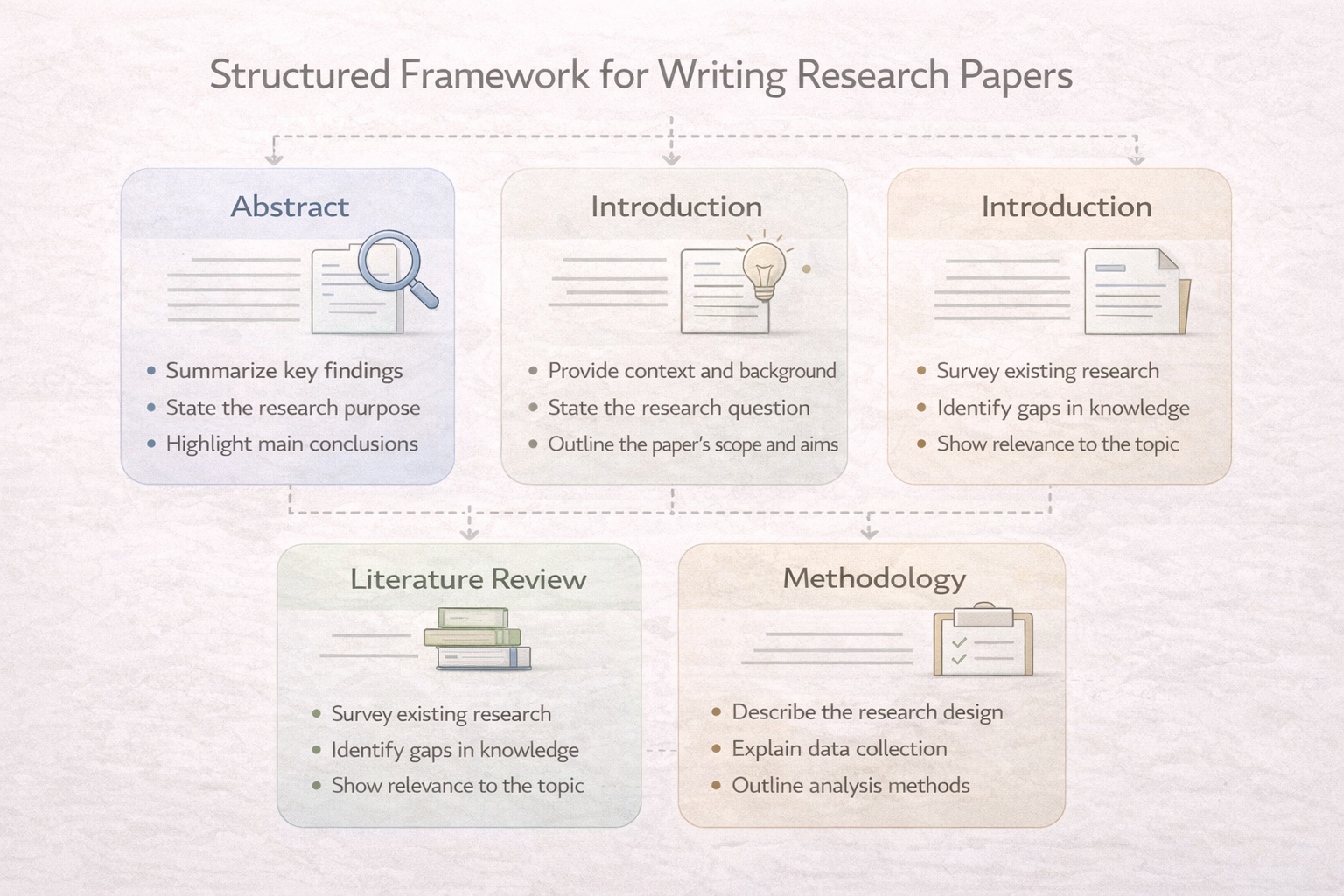
Writing a research paper is not simply a matter of filling sections with content. High-quality academic writing follows recognisable intellectual frameworks that guide how problems are framed, evidence is presented, and contributions are articulated. The image accompanying this article outlines a sequence of widely used frameworks that correspond to the major sections of a research paper.
This article expands those frameworks into a practical academic guide. Rather than treating them as rigid templates, it explains how each framework supports clarity, coherence, and analytical depth. The purpose is to help university students move beyond descriptive writing toward structured scholarly argumentation.

Why Framework-Driven Writing Improves Research Quality
Many students struggle with research papers because they attempt to write sections intuitively. This often leads to unfocused abstracts, introductions without direction, literature reviews that summarise rather than analyse, and results sections that lack interpretation. Writing frameworks address this problem by providing intellectual scaffolding.
A framework does not restrict originality. Instead, it ensures that originality is communicated logically. Examiners and peer reviewers are trained to evaluate work according to disciplinary expectations, and framework-aligned writing aligns naturally with those expectations.
Using structured frameworks also improves efficiency. When each section has a clear purpose, students spend less time rewriting and more time refining arguments.
Structuring the Abstract Using the IMRaD Framework
The abstract is often the most read part of a research paper, yet it is frequently the weakest. The IMRaD framework—Introduction, Methods, Results, and Discussion—offers a concise structure that ensures completeness and balance.
An effective abstract briefly introduces the research problem, outlines the methodological approach, summarises key findings, and indicates the broader meaning of those findings. Each element serves a distinct communicative function, preventing the abstract from becoming a vague overview.
Importantly, the abstract should reflect the paper accurately rather than promise more than is delivered. Overstated claims at this stage undermine credibility.
Examiner expectation: A strong abstract allows the reader to understand what was done, how it was done, and why it matters—without reading the full paper.
Framing the Introduction with the CARS Framework
The introduction sets the intellectual trajectory of the entire paper. The CARS framework—Create a Research Space—guides writers through three moves: establishing the research territory, identifying a gap, and occupying that gap.
First, the writer situates the topic within an existing field by referencing key debates or problems. Second, a limitation, tension, or absence in the literature is identified. Finally, the study’s purpose is positioned as a response to that gap.
This structure prevents introductions from becoming general background sections. Instead, they become persuasive arguments for why the research deserves attention.
Analysing Literature Using the CLAIM Framework
Literature reviews are commonly misunderstood as summaries of prior studies. The CLAIM framework—Context, Literature, Analysis, Interpretation, and Motivation—repositions the review as an analytical section.
Rather than listing sources, the writer groups literature thematically, evaluates methodological or theoretical patterns, and interprets their implications. The final step links this analysis directly to the current study’s motivation.
This approach demonstrates scholarly maturity by showing how existing knowledge informs, rather than replaces, the present research.
| Aspect | Descriptive Review | CLAIM-Based Review |
|---|---|---|
| Use of sources | Summarised individually | Synthesised thematically |
| Critical engagement | Minimal | Explicit evaluation |
| Link to research gap | Weak or implicit | Direct and justified |
Designing the Methodology Section with the PASTE Framework
The methodology section explains how the research was conducted and why those choices were appropriate. The PASTE framework—Participants, Approach, Setting, Techniques, and Ethics—ensures methodological transparency.
Each element addresses a specific reviewer concern. Who was studied? What research design was used? Where did the study take place? How were data collected and analysed? Were ethical standards followed?
Clear methodological justification enhances reliability and allows readers to assess the validity of findings. Vague descriptions, by contrast, often lead to lower marks or rejection.
Critical warning: Methodology must justify decisions, not merely describe procedures.
Interpreting Findings Through the SIRF Framework
Results and discussion sections are frequently merged but poorly integrated. The SIRF framework—Summary, Interpretation, Relevance, and Future implications—provides a structured way to move from data to meaning.
First, findings are summarised without interpretation. Next, those findings are analysed in relation to research questions and literature. Their relevance is then explained in theoretical or practical terms, followed by implications for future research.
This framework prevents a common mistake: presenting results without explaining their significance.
| Weak Practice | Framework-Based Improvement |
|---|---|
| Repeating numerical results | Interpreting patterns and trends |
| No link to literature | Explicit comparison with prior studies |
| Unclear implications | Focused relevance and future directions |
How These Frameworks Work Together
Each framework supports a specific section, but their true strength lies in integration. A well-structured abstract reflects a focused introduction. A clear research gap leads naturally to a justified methodology. Analytical literature review themes inform interpretation of results.
When frameworks align, the research paper reads as a coherent argument rather than a collection of sections. This coherence is a key indicator of high-level academic work.
Students who apply these frameworks consistently tend to receive stronger feedback, higher marks, and clearer revision guidance.
Applying Frameworks to Coursework and Dissertations
Although these frameworks are commonly associated with journal articles, they apply equally to undergraduate and postgraduate assignments. Marking rubrics consistently reward structure, justification, and analytical depth.
Using frameworks does not increase word count. Instead, it improves the efficiency of each paragraph by ensuring that every section fulfils its academic function.
Over time, these frameworks become internalised, allowing writers to adapt them flexibly across disciplines and research contexts.
Developing Framework Literacy as an Academic Skill
Framework literacy—the ability to recognise and apply structural models—is a defining feature of advanced academic writing. It distinguishes descriptive work from analytical scholarship.
Rather than memorising templates, students should focus on understanding why each framework exists and how it supports scholarly communication.
Ultimately, strong research writing is not about rigid formulas, but about disciplined thinking expressed through clear structure.


Comments