Understanding how to cite a book chapter in APA 7 is essential for academic writing in psychology, education, business, social sciences, and many other disciplines. Unlike citing an entire book, referencing a single chapter requires careful attention to authorship, editors, page ranges, and publication details. Many students confuse chapter authors with book editors or format the reference incorrectly, leading to avoidable mark deductions.
APA 7th edition introduced several updates to citation formatting, including expanded author limits and DOI presentation changes. This guide explains clearly how to cite a book chapter in APA 7, covering reference list entries, in-text citations, edited volumes, electronic books, and special cases. By mastering these rules, you ensure precision, academic integrity, and professional presentation.
When Do You Cite a Book Chapter Instead of a Whole Book?
You cite a book chapter when the chapter has a different author from the overall book editor. Many academic books are edited collections, where individual scholars contribute separate chapters. In such cases, you must credit the chapter author, not the book editor, in your in-text citation.
If the chapter author and the book author are different, always cite the chapter author in-text.
If the entire book is written by one author and you are using multiple chapters, then you cite the whole book rather than individual chapters.
APA 7 Reference Format for a Chapter in an Edited Book
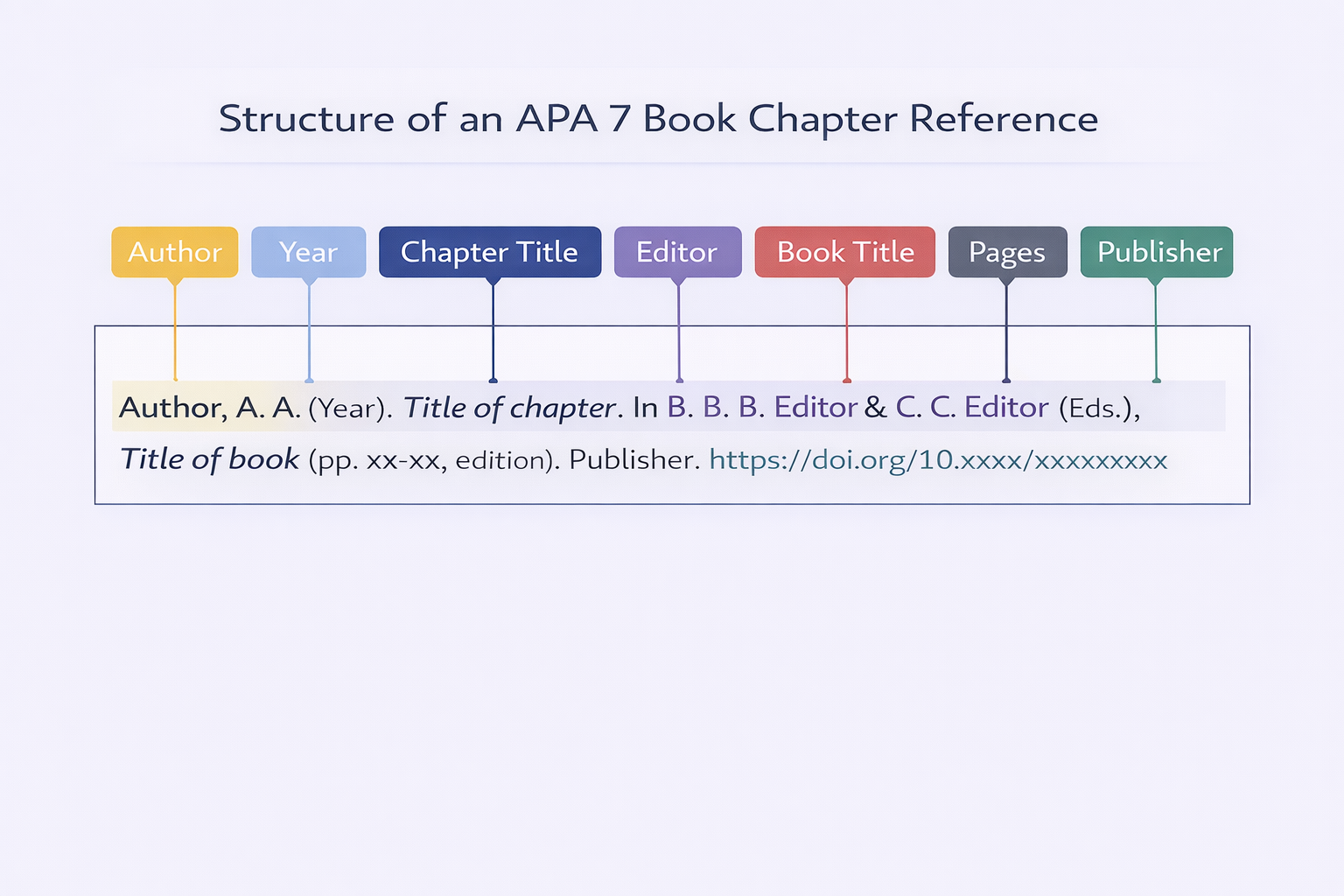
The standard APA 7 format for a chapter in an edited book is structured as follows:
Author, A. A. (Year). Title of chapter. In E. E. Editor (Ed.), Title of book (pp. xx–xx). Publisher. DOI (if available)
Each element serves a specific purpose. The chapter author appears first, followed by the publication year in parentheses. The chapter title is written in sentence case. The editor’s name appears after the word “In,” and the book title is italicised.
| Element | Example |
|---|---|
| Chapter Author | Smith, J. A. |
| Year | (2022). |
| Chapter Title | Social identity in digital spaces. |
| Editor | In R. Brown (Ed.), |
| Book Title (Italicised) | Perspectives on modern sociology |
| Page Range | (pp. 45–67). |
| Publisher | Academic Press. |
This structured format ensures clarity and consistency in your reference list.
Example of a Full APA 7 Book Chapter Reference
Smith, J. A. (2022). Social identity in digital spaces. In R. Brown (Ed.), Perspectives on modern sociology (pp. 45–67). Academic Press. https://doi.org/10.xxxx/xxxxx
Notice that APA 7 includes the DOI in URL format when available. If no DOI exists and the book is not retrieved online, no URL is required.
How to Write In-Text Citations for Book Chapters
When citing a book chapter in-text, you cite the chapter author, not the editor.
Parenthetical citation: (Smith, 2022)
Narrative citation: Smith (2022) argues that digital identity shapes social interaction.
If directly quoting, include a page number:
(Smith, 2022, p. 52)
Always include page numbers when quoting directly from a book chapter.
Multiple Editors in APA 7 Book Chapters
If a book has more than one editor, list all editors in the reference entry using an ampersand (&) before the final name.
Example format:
In R. Brown & L. Taylor (Eds.),
The abbreviation “Eds.” is used instead of “Ed.” when there are multiple editors.
Citing a Chapter from an E-Book
When citing an electronic book chapter, the structure remains the same. The only difference is the inclusion of a DOI or URL if the chapter was accessed online.
If the book was accessed through an academic database and does not have a DOI, APA 7 does not require you to include the database name. Simply format the reference like a print version unless a DOI or stable URL is available.
| Format | Include DOI/URL? |
|---|---|
| Print Book Chapter | No |
| E-Book with DOI | Yes (Include DOI) |
| E-Book without DOI | No (Unless stable URL required) |
This distinction prevents unnecessary or incorrect URL inclusion.
Common Mistakes When Citing Book Chapters in APA 7
- Citing the editor as the author in-text.
- Capitalising every word in the chapter title.
- Forgetting to italicise the book title.
- Omitting page ranges.
- Including publisher location (not required in APA 7).
Do not include the city or location of the publisher in APA 7 references.
APA 7 removed publisher location requirements, a common area of confusion for students familiar with older editions.
Special Case: Chapter in a Book with No Editor
If the book has a single author and no editor, and you are referencing a specific chapter, you generally cite the entire book in the reference list rather than isolating the chapter. In-text, you may include a chapter number if helpful:
(Johnson, 2020, Chapter 3)
This approach avoids unnecessary structural complexity.
Ensuring Accuracy and Academic Integrity
Accurate referencing demonstrates academic responsibility. Misattributing chapter authorship or formatting entries incorrectly may affect grading and credibility. Always cross-check your formatting against the official APA 7 guidelines or your institution’s referencing handbook.
Reference management tools such as Zotero, Mendeley, or EndNote can assist, but automatic generators should always be reviewed manually to ensure compliance.
Mastering How to Cite a Book Chapter in APA 7
Learning how to cite a book chapter in APA 7 requires understanding authorship structure, formatting order, and DOI rules. The key principles are straightforward: cite the chapter author in-text, list editors after “In” in the reference, italicise the book title, include page ranges, and use DOI formatting when available.
Precision in referencing reflects academic maturity. By applying these structured rules consistently, you strengthen the credibility, clarity, and professionalism of your academic writing.
Comments