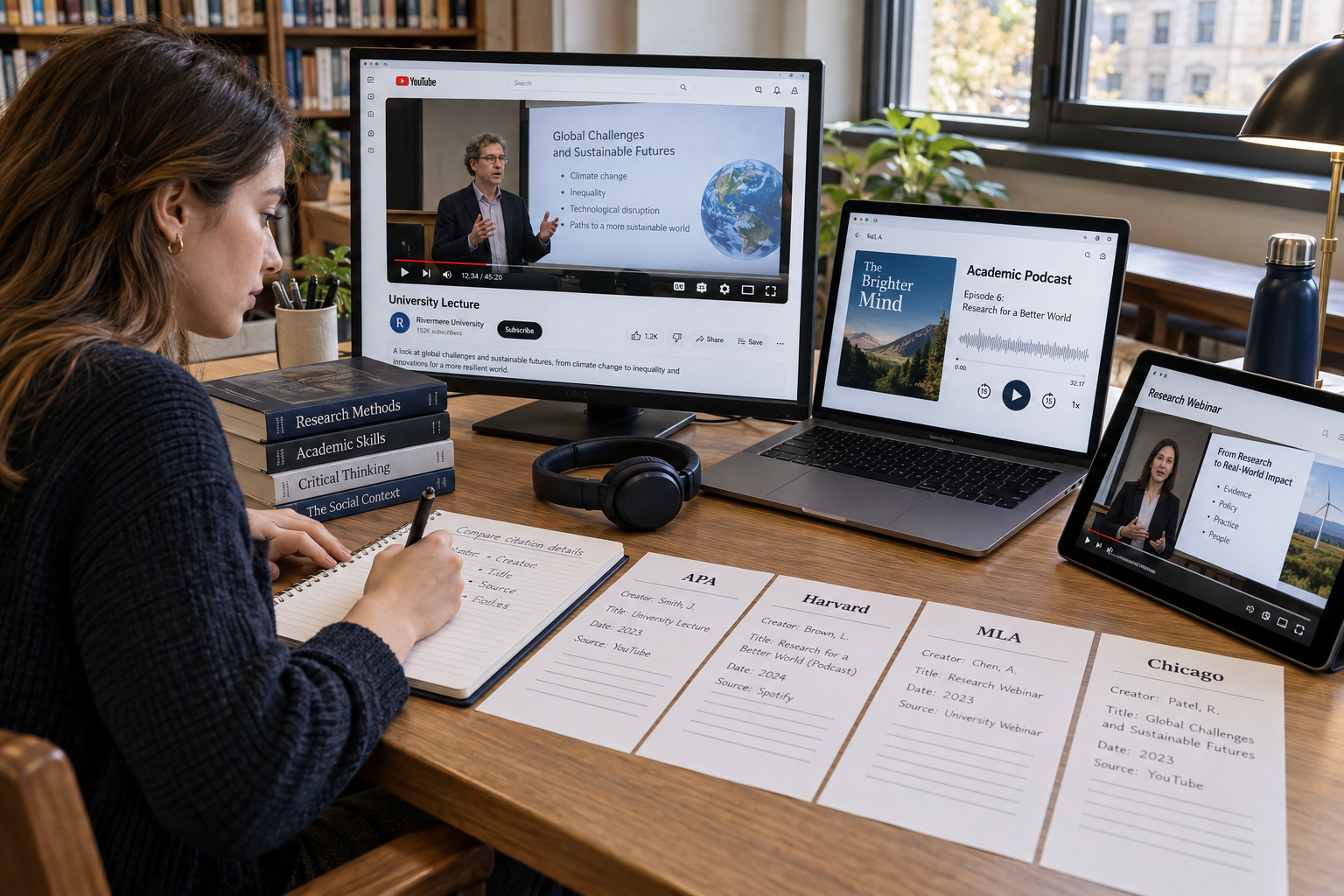
University research now extends far beyond books and journal articles. Students regularly encounter expert lectures on YouTube, interviews in academic podcasts, professional webinars, conference recordings, public talks, and institutional video resources that can contribute useful evidence to an assignment. These sources can be academically valuable, but their unusual combination of speakers, uploaders, hosts, platforms, dates, and episode titles often makes them harder to reference correctly.
Learning how to cite a YouTube video, podcast, and webinar in university assignments therefore requires more than copying a URL into the reference list. Students need to identify who is responsible for the material, distinguish a speaker from an uploader, determine whether a webinar is retrievable, record the correct publication or delivery date, and use a timestamp when referring to a specific spoken passage. The exact format then changes according to APA, Harvard, MLA, or Chicago.
The first priority is always the referencing system specified by the university or lecturer. Epic Essay's academic referencing guide explains that citation styles differ in punctuation, ordering, in-text conventions, and reference-list structure. This guide applies those principles specifically to audiovisual and spoken digital sources so that students can cite them accurately without treating every online source as an ordinary webpage.
Can You Use YouTube Videos, Podcasts, and Webinars as Academic Sources?
YouTube videos, podcasts, and webinars can be used in academic work when they provide material that is relevant to the research question and appropriate to the discipline. A recorded university lecture, government briefing, expert interview, conference presentation, professional association webinar, or podcast featuring a recognised researcher may provide evidence that cannot be found in exactly the same form elsewhere. In subjects such as media studies, communication, politics, education, cultural studies, and contemporary history, audiovisual sources may even form part of the material being analysed.
However, being available online does not make a source academically reliable. Students should evaluate who produced the material, the speaker's expertise, the organisation behind the publication, the purpose of the content, whether claims are supported by evidence, and whether a stronger primary or peer-reviewed source is available. A university professor explaining their own research in a recorded seminar carries a different evidential weight from an anonymous commentary channel making unsupported claims.
Referencing quality and source quality are separate issues. A perfectly formatted citation does not make a weak source academically authoritative. Where a YouTube video or podcast merely summarises a journal article that you can access directly, citing the original academic research will usually provide stronger evidence.
Use audiovisual sources because they contribute relevant evidence or analysis, not simply because they are easier to access than scholarly literature.
What Information Should You Record Before Creating the Citation?
Audiovisual references become much easier to construct when the relevant metadata are recorded while the source is open. Students often save only the URL and later discover that they no longer remember the exact episode title, publication date, speaker, channel, webinar organiser, or timestamp. These details can determine both the reference-list entry and the in-text citation.
The information required differs slightly by medium. A YouTube citation commonly needs the creator or uploader, date, title, platform, and URL. A podcast normally requires an episode title, podcast series title, host or creator where relevant, date, publisher or production organisation, and URL. A webinar may require the presenter, title, sponsoring organisation, delivery or publication date, format, and location of a retrievable recording.
The following table provides a practical collection checklist.
| Source Type | Information to Record | Common Point of Confusion |
|---|---|---|
| YouTube video | Creator or channel, exact upload date, video title, platform, URL, relevant timestamp | The speaker may be different from the channel that uploaded the video |
| Podcast episode | Host or creator where required, episode title, podcast title, episode number, date, producer, URL | The episode title and podcast series title are separate elements |
| Recorded webinar | Presenter, webinar title, sponsor or publisher, date, recording platform, URL | The date delivered may differ from the date the recording was uploaded |
| Live unrecorded webinar | Presenter, title, organisation, delivery date, event details | The source may not be retrievable by readers |
Collecting these elements also makes citation generators easier to check. Automated tools frequently confuse the YouTube channel with the author, omit podcast hosts, or treat webinar titles as ordinary webpages. The student remains responsible for verifying the final reference against the required style.
How to Cite a YouTube Video in APA 7
APA 7 treats a YouTube video as audiovisual media. The author position is normally occupied by the person or organisation responsible for the channel, followed by the channel name in square brackets when it differs from the author's real name. The exact upload date is included because online videos can be published at a specific point in time, and the title is followed by the description "[Video]."
A practical APA format is:
Author, A. A. [Channel name]. (Year, Month Day). Title of video [Video]. YouTube. URL
For an organisational channel, the format can be simplified because the organisation itself functions as the author. An illustrative example would be: Learning Research Centre. (2026, March 4). Formative assessment strategies for university teaching [Video]. YouTube. URL. The corresponding parenthetical citation would be (Learning Research Centre, 2026).
If you quote or paraphrase a specific spoken passage, APA permits a timestamp to function as the locator because a video has no conventional page number. An in-text citation could therefore appear as (Learning Research Centre, 2026, 12:41). Students can review the broader author-date logic in Epic Essay's APA 7 in-text citation guide.
How to Cite a Podcast Episode in APA 7
A podcast episode is cited differently from an entire podcast series because the individual episode is the source actually used. APA can identify the host in the author position, followed by the role "(Host)." The episode title appears before the description "[Audio podcast episode]," while the title of the overall podcast follows after "In."
A practical APA structure is:
Host, A. A. (Host). (Year, Month Day). Title of episode (No. X) [Audio podcast episode]. In Title of podcast. Production company. URL
An illustrative example could be: Patel, R. (Host). (2026, February 12). Designing inclusive university classrooms (No. 18) [Audio podcast episode]. In Teaching Futures. Academic Learning Network. URL. The in-text citation would normally appear as (Patel, 2026).
If the episode has no formal episode number, that element can simply be omitted. If a podcast is the object of analysis across its entire series rather than one particular episode, the reference needs to identify the whole podcast instead. Students should always cite the level of the source they actually used.
How to Cite a Recorded Webinar in APA 7
A recorded webinar that readers can retrieve can be referenced as an online audiovisual source. The presenter normally occupies the author position, followed by the date, webinar title, a description of the format, the sponsoring organisation or publisher, and the URL. This allows readers to locate the presentation rather than merely knowing that it once took place.
A practical format is:
Presenter, A. A. (Year, Month Day). Title of webinar [Webinar]. Sponsoring organisation. URL
An illustrative entry could therefore read: Morris, T. (2026, January 20). Evidence synthesis for postgraduate researchers [Webinar]. University Research Centre. URL. The corresponding parenthetical citation would be (Morris, 2026).
A live webinar that was never recorded creates a different issue because readers cannot retrieve it. Depending on the circumstances and institutional application of APA, non-retrievable material may need to be treated similarly to personal communication rather than included as an ordinary reference-list source. Students should check their university's APA guidance when citing private Zoom sessions, module-only webinars, or presentations unavailable to the public.
How to Cite YouTube, Podcasts, and Webinars in Harvard Style
Harvard referencing requires special caution because universities use different Harvard variants. There is no single worldwide Harvard manual governing punctuation and source formats. The University of Leeds Harvard guidance for online videos, for example, uses the screen name or username, publication year, title, online designation, access date, and URL.
Using that institutional model, a YouTube video can follow this structure:
Screen name or username. Year. Title. [Online]. [Accessed Day Month Year]. Available from: URL
A podcast under Leeds Harvard uses the originator, year, episode title, podcast title, format, access date, and URL. The university's podcast referencing guidance provides the following overall pattern: originator, year, episode title, podcast title, "[Podcast]," access date, and location.
For webinars, Leeds distinguishes between recordings and non-retrievable live events. Its Harvard webinar guidance includes the presenter, year, presentation title, webinar designation, sponsor, access date, and URL for a recording. A live webinar that is not publicly available can instead be identified by presenter, title, organisation, and date delivered.
Do not assume that another university's Harvard example automatically applies to your assignment. Use your own institution's Harvard guide where it specifies a different structure.
How to Cite YouTube Videos, Podcasts, and Webinars in MLA 9
MLA 9 builds citations from core elements such as author, title, container, contributor, publisher, date, and location. This flexible structure is useful for digital media because the same material can appear in different containers. A lecture delivered at a conference, for example, may later appear as a YouTube recording, making the online platform part of the citation context.
For a straightforward YouTube video, a practical Works Cited structure is:
Creator or Channel. "Title of Video." YouTube, Day Month Year, URL.
If the video is important because of a particular speaker rather than the uploader, MLA allows the citation to foreground the contributor most relevant to the research. Additional information about the uploader can then be included as appropriate. This flexibility is useful when a university channel uploads a guest lecture by a named academic.
For podcast episodes, Purdue OWL's MLA guidance begins with the episode title in quotation marks, followed by the podcast title as the larger container and then the publication information. A practical pattern is:
"Title of Episode." Title of Podcast, hosted by Name where relevant, Publisher, Day Month Year, URL.
A recorded webinar should be cited according to the form in which the student accessed it. If a webinar recording is hosted on YouTube, MLA can treat that recording as an online video. Purdue's guidance similarly explains that recorded presentations or discussions should be cited according to the medium through which they are retrieved.
How Chicago Style Handles Videos, Podcasts, and Recorded Webinars
Chicago currently offers both Notes and Bibliography and Author-Date systems, so students must first determine which version their module requires. Current Chicago Author-Date guidance includes specific models for videos and podcasts and identifies elements such as creator, year, title, type of recording, date, duration, and URL.
A practical Chicago Author-Date pattern for a YouTube recording is:
Creator. Year. "Title." YouTube video, Month Day, Year. Duration. URL.
A podcast episode can identify the host, podcast title, season or episode where relevant, episode title, producer, publication date, medium, duration, and URL. Chicago's examples demonstrate that duration can be useful for audiovisual sources because it helps describe the particular recording being cited.
In Notes and Bibliography style, the same information is reorganised into a numbered note and, where appropriate, a bibliography entry. Current Chicago Notes and Bibliography examples also include a virtual lecture later posted on YouTube, demonstrating how a recorded webinar or lecture can identify both its original event context and the platform on which the recording was published.
A shortened Chicago note can also include a timestamp when referring to a specific moment. This makes the citation much more useful to readers than directing them to the beginning of an hour-long recording.
APA, Harvard, MLA, and Chicago: Quick Citation Comparison
The same YouTube video, podcast, or webinar can produce noticeably different citations depending on the style. The differences are not merely cosmetic. Each system places emphasis on different bibliographic elements and connects the full reference with the text in a different way.
| Style | Typical In-Text System | YouTube or Video Emphasis | Podcast Emphasis | Important Consideration |
|---|---|---|---|---|
| APA 7 | Author-date | Author or channel, exact date, title, [Video], YouTube | Host, episode title, [Audio podcast episode], podcast series | Timestamp can replace page number for a specific passage |
| Harvard | Author-date | Creator or screen name, year, title, online source, access details | Originator, episode title, podcast title, access information | Exact format varies between universities |
| MLA 9 | Author or title plus locator where needed | Creator, title, YouTube as container, publication date | Episode title followed by podcast as container | The contributor most relevant to the research may be foregrounded |
| Chicago | Notes or author-date | Creator, title, medium, date, duration, URL | Host, series, episode, date, medium, duration | First determine whether Notes-Bibliography or Author-Date is required |
This comparison also explains why students should avoid copying a citation generated in one style and modifying only the punctuation. The identity and ordering of bibliographic elements can change between systems. Epic Essay's in-text citation guide provides a broader comparison of how major referencing styles connect evidence in the body of an assignment with the final reference list.
How to Use Timestamps Instead of Page Numbers
Audiovisual sources normally do not contain conventional page numbers, so a timestamp is the most useful locator when the assignment refers to a particular statement or moment. Instead of forcing a reader to watch an entire 50-minute lecture, a timestamp can direct them to the exact location of the cited evidence.
In APA, a quotation from audiovisual material can use a timestamp such as (Morgan, 2026, 14:32). Chicago similarly allows precise time locations, and its official examples demonstrate timestamp ranges for video material. MLA can also use a time-based locator where a specific passage of an audiovisual work needs to be identified.
Harvard practice varies between institutions, so students should check local guidance before deciding how timestamps should appear alongside the author and year. Where no explicit rule is provided, the goal should remain traceability: the citation should make it reasonably easy for the reader to find the exact passage being discussed.
Timestamps are especially valuable for direct quotations. When paraphrasing the overall argument of a short video or podcast episode, a locator may be unnecessary unless required by the referencing system or university. The level of precision should match the claim being made.
What If the Speaker and YouTube Channel Are Different?
This is one of the most common complications in audiovisual referencing. A university, professional association, publisher, or conference organiser may upload a lecture delivered by someone else. The video's speaker is therefore not automatically the same as the uploader responsible for the online publication.
Which person or organisation appears first can depend on the citation system and the purpose of the citation. If an assignment analyses a named scholar's argument, some styles allow the scholar to be foregrounded while still identifying the platform or uploader. If the video is institutional content produced by the organisation itself, the channel may appropriately function as the author.
The same issue occurs with podcasts. A podcast may have a permanent host, a guest expert, a production organisation, and an episode title. If you are citing the episode as a whole, the style's normal podcast structure should be followed. If your analysis specifically concerns an interviewee's statement, that person's role can be explained clearly in the surrounding sentence even when the reference remains organised under the host or episode.
Do not automatically treat the person speaking on screen as the uploader or bibliographic author. Check the source metadata and follow the contributor rules of the required citation style.
How to Cite a Webinar That Is Not Publicly Available
Recorded webinars with stable URLs are straightforward because readers can retrieve them. Private webinars, live Zoom sessions, university workshops, and invitation-only professional presentations are more complicated because the audience may have no way to access the material after the event. Referencing systems often distinguish retrievable from non-retrievable sources for this reason.
Under Harvard systems such as Leeds, a live webinar that was not recorded can still be described using the presenter's name, year, webinar title, sponsor, and delivery date without pretending that a public URL exists. APA may treat genuinely non-retrievable communication differently from a publicly archived webinar, so students should check institutional guidance before creating a standard reference-list entry.
MLA can describe a live presentation using the rules for speeches, lectures, or oral presentations, while Chicago can provide detailed event information in a note. In every case, students should describe the source they actually experienced rather than inserting a link to an unrelated organisation homepage.
This distinction also applies to recorded module content behind a university login. A lecturer's private recording may be retrievable by classmates but inaccessible to external readers. The module's referencing rules should therefore be checked before treating it like a public YouTube video.
Should You Cite the Transcript or the Recording?
Many video and podcast platforms provide automatic transcripts. If you use the transcript merely to locate words spoken in the recording, the audiovisual source normally remains the source being cited. The automatic transcript is a representation of that recording rather than necessarily a separately published scholarly document.
However, some organisations publish an official transcript as an independent webpage or document. If the transcript itself is the material you consulted and it has its own stable publication information, citing that document may be appropriate. This can be particularly useful when the transcript contains corrections or editorial material not present in an automatically generated version.
Students should also verify quotations against the actual recording where possible. Automated transcription can mishear names, specialist terminology, statistics, or accented speech. A perfectly formatted citation cannot correct a quotation that was copied inaccurately from a machine-generated transcript.
When quoting spoken material, the final wording should accurately reflect what was said, and the timestamp should direct the reader to the corresponding location. This provides a stronger audit trail than citing an unverified transcript alone.
Common Mistakes When Referencing Videos, Podcasts, and Webinars
A common mistake is treating every source as a webpage. Students sometimes enter the page title, website name, and URL while ignoring the speaker, uploader, podcast series, webinar sponsor, or publication date. This loses important information about authorship and the type of source being used.
Another mistake is citing YouTube as the author. YouTube is generally the platform or container, not the creator of every video it hosts. The relevant individual, organisation, or channel should be identified according to the rules of the citation style.
Podcast citations frequently fail because students reference the entire programme when they actually used one episode. The individual episode title should normally be identified when the evidence came from that episode. Similarly, citing only a podcast guest without identifying the episode can make the material difficult to retrieve.
Webinars create another predictable error: students invent a public URL for a live session that was never archived. The reference should accurately represent whether the webinar is publicly retrievable. Fabricating or substituting source information reduces rather than improves academic credibility.
Never copy an automatically generated citation without checking it against the actual video, podcast episode, or webinar record. Missing creators, wrong dates, incomplete titles, and incorrect source types are common automated-citation errors.
A Step-by-Step Checklist for Citing Audiovisual Sources
A systematic process prevents most citation errors. Start by deciding whether the source is academically appropriate, then identify the medium and collect its metadata before applying the required referencing style. This is more reliable than beginning with a citation generator and attempting to repair the output later.
Use the following checklist before submission:
- Confirm that the source is relevant and credible enough for the academic purpose.
- Identify whether it is a YouTube video, podcast episode, recorded webinar, or non-retrievable live presentation.
- Record the creator, speaker, host, uploader, or responsible organisation as applicable.
- Copy the exact title rather than shortening it in the reference list.
- Record the complete publication, upload, or delivery date.
- Identify the podcast series, YouTube platform, sponsor, publisher, or event where required.
- Save the direct stable URL to the source rather than a generic homepage.
- Record a timestamp when you use a specific quotation or spoken passage.
- Check whether your assignment requires APA, Harvard, MLA, or Chicago.
- For Harvard, follow your own university's prescribed variant.
- For Chicago, determine whether Notes and Bibliography or Author-Date is required.
- Make sure every in-text citation or footnote corresponds with the final reference.
- Verify quotations against the actual recording rather than trusting automatic transcripts.
- Proofread the citation manually even if software generated the first version.
This final audit is particularly important for digital sources because their metadata are displayed differently across platforms. Epic Essay's guide to common referencing mistakes explains that consistency and source verification are essential even when citation software is used.
Citing YouTube Videos, Podcasts, and Webinars with Academic Confidence
Knowing how to cite a YouTube video, podcast, and webinar in university assignments begins with correctly identifying the source. A video needs its responsible creator or channel, a podcast episode must be distinguished from the overall series, and a webinar should be treated differently depending on whether readers can retrieve a recording. Titles, dates, platforms, contributors, URLs, and timestamps then provide the information needed to trace the evidence.
APA, Harvard, MLA, and Chicago apply these elements differently. APA uses specific audiovisual descriptions and author-date citations, Harvard follows institutional author-date conventions, MLA organises digital media through its flexible container system, and Chicago provides both Notes and Bibliography and Author-Date approaches. Following the correct style from the beginning prevents inconsistent references later.
Most importantly, citation format should never distract from source quality. Evaluate who created the material, use original academic evidence where it is more appropriate, verify quotations and claims, and provide precise timestamps when discussing particular moments. When the source is credible and the citation accurately identifies what you actually used, audiovisual media can be integrated into university assignments with the same scholarly transparency expected of any other academic evidence.
Comments