Understanding how to cite an online report in Harvard style is essential for producing academically credible work. University students frequently rely on government publications, industry analyses, policy briefs, NGO reports, and market research documents that are available online. However, many lose marks because they treat these sources like websites rather than formal reports.
Harvard referencing requires precise formatting, especially when dealing with corporate authors, publication dates, report titles, and URLs. This guide explains exactly how to structure in-text citations and reference list entries for online reports, including situations where information is missing. By the end, you will be able to cite online reports confidently and consistently in Harvard style.
What Counts as an Online Report in Harvard Referencing?
An online report is a formal document published digitally by an organisation, government body, research institute, charity, or company. These reports often include data analysis, policy recommendations, annual summaries, or research findings. Unlike informal web pages, reports are structured documents with clear authorship and publication details.
Common examples include:
- Government policy reports
- Annual corporate sustainability reports
- World Bank or IMF publications
- Industry white papers
- Research institute briefing documents
In Harvard style, these are treated as formal publications, not simple web pages.
Basic Harvard Reference Format for an Online Report
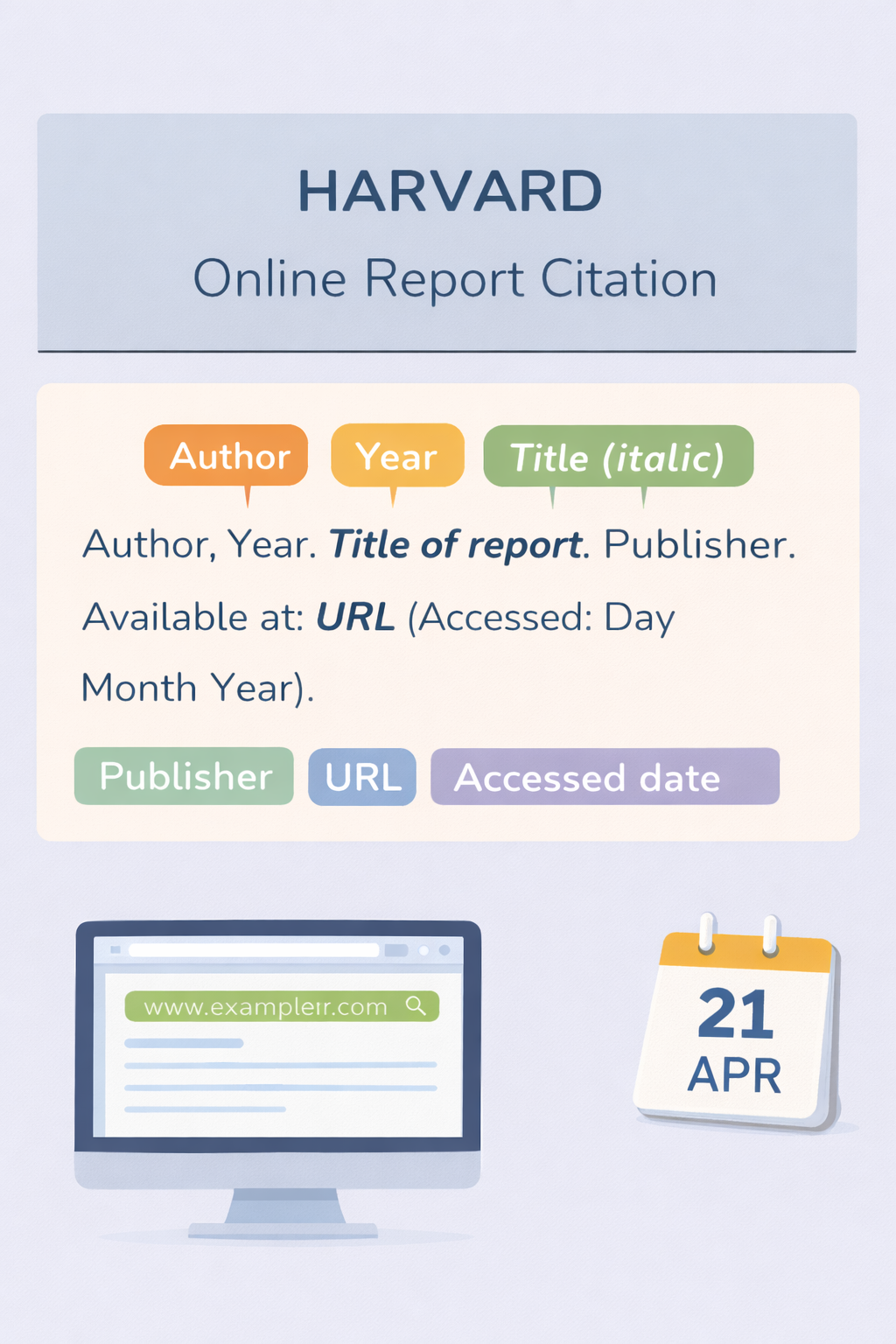
The standard Harvard reference format for an online report is:
Author/Organisation (Year) Title of report. Place of publication: Publisher (if applicable). Available at: URL (Accessed: Day Month Year).
Each element plays a specific role. The organisation is often the author. The year refers to the publication year of the report. The title is italicised and written in sentence case. The URL is introduced with “Available at,” and the access date is required because online content can change.
| Element | Example |
|---|---|
| Author/Organisation | World Health Organization |
| Year | (2023) |
| Title (Italicised) | Global tuberculosis report 2023 |
| Publisher | Geneva: WHO |
| URL | Available at: https://www.who.int/... |
| Access Date | (Accessed: 10 January 2026) |
This format ensures clarity and consistency across academic submissions.
Full Example of an Online Report in Harvard Style
World Health Organization (2023) Global tuberculosis report 2023. Geneva: WHO. Available at: https://www.who.int/publications (Accessed: 10 January 2026).
If the organisation is both author and publisher, you may omit repetition depending on your university guidelines. Always check your institutional referencing guide.
How to Write In-Text Citations for Online Reports
Harvard style uses an author-date system. For online reports, the author is typically the organisation.
Parenthetical citation: (World Health Organization, 2023)
Narrative citation: According to the World Health Organization (2023), tuberculosis remains a leading cause of global mortality.
If quoting directly, include page numbers if available:
(World Health Organization, 2023, p. 45)
Always include page numbers when directly quoting from a report, if pagination exists.
What If There Is No Named Individual Author?
Most online reports are written by organisations rather than individuals. In Harvard style, the organisation becomes the author. Do not write “Anonymous” unless the document explicitly states this.
If both an individual author and an organisation are listed, use the named author in your reference unless your university specifies otherwise.
How to Cite a Report with No Date
If the publication date is not available, use “n.d.” (no date) in place of the year.
Example:
Greenpeace (n.d.) Climate risk assessment report. Available at: https://www.greenpeace.org/... (Accessed: 12 January 2026).
Your in-text citation would appear as:
(Greenpeace, n.d.)
Referencing Government and Institutional Reports
Government departments are treated as corporate authors. For example:
Department for Education (2022) Higher education participation statistics. London: Department for Education. Available at: https://www.gov.uk/... (Accessed: 5 February 2026).
Be consistent with the official department name as it appears on the publication.
Common Mistakes When Citing an Online Report in Harvard Style
- Listing the website name instead of the report author.
- Failing to italicise the report title.
- Omitting the access date.
- Confusing reports with general web pages.
- Using incomplete URLs or broken links.
These small errors can significantly affect your referencing accuracy and overall grade.
Do You Always Need a Place of Publication?
Some modern Harvard guidelines are flexible regarding place of publication for online reports. If the report clearly lists a location, include it. If not, follow your institutional handbook. When in doubt, prioritise consistency throughout your reference list.
Mastering How to Cite an Online Report in Harvard Style
Learning how to cite an online report in Harvard style requires attention to five essential elements: corporate or individual author, publication year, italicised report title, availability statement with URL, and access date. In-text citations follow the standard author-date format, with page numbers included for direct quotations.
Accurate referencing demonstrates academic integrity, strengthens credibility, and aligns your work with university standards. By applying these structured principles consistently, you ensure that every online report you use is cited correctly and professionally.
Comments