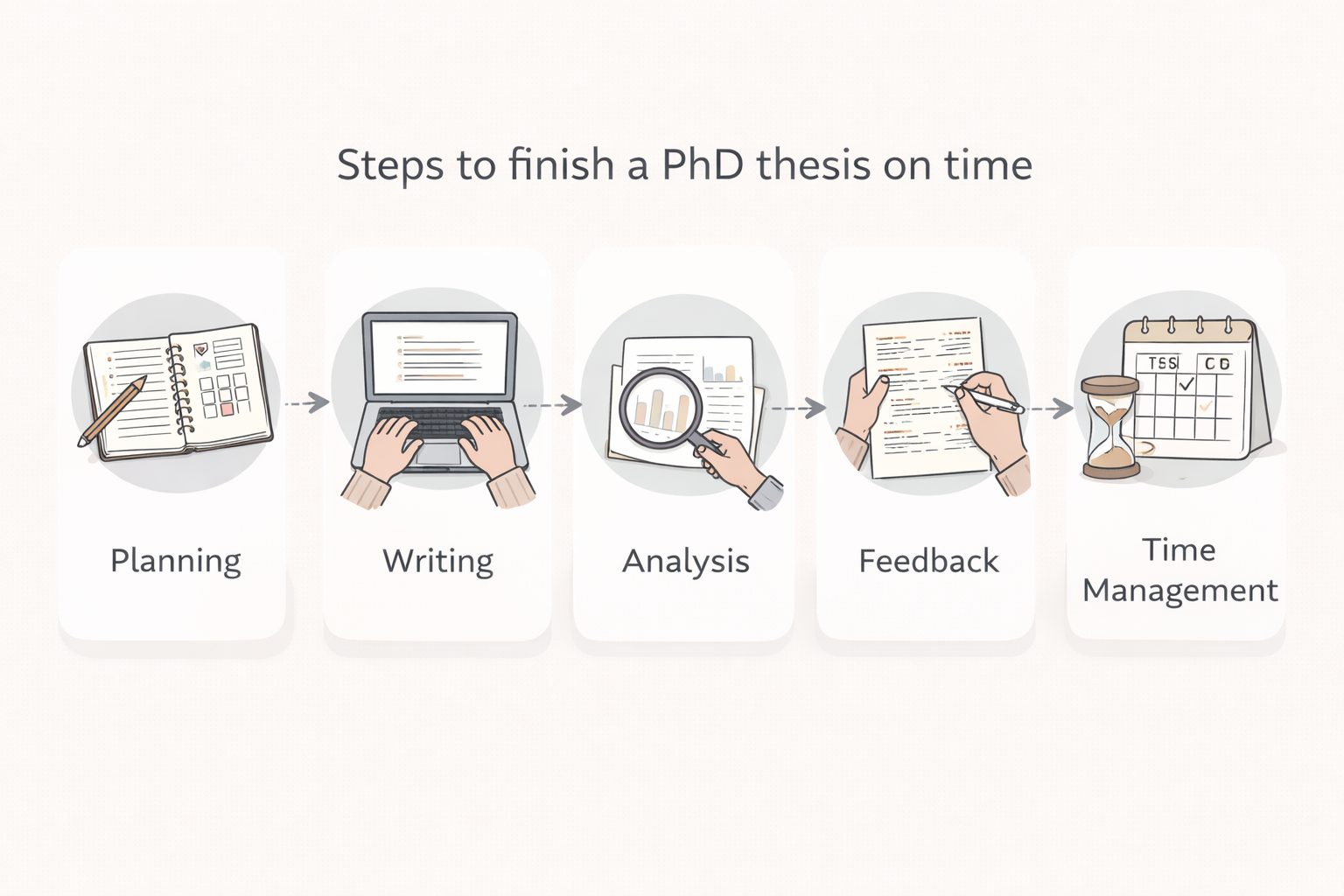
Finishing a PhD thesis on time is one of the most persistent challenges in doctoral education. Delays rarely occur because candidates lack ability or motivation; they occur because writing, analysis, and institutional requirements are mismanaged or approached in the wrong order. The framework shown above summarises proven strategies used by doctoral candidates who complete on schedule, but each point only works when applied with academic precision rather than generic productivity advice.
This article unpacks those strategies in depth and explains why they matter in doctoral research, how they reduce risk, and what typically goes wrong when candidates ignore them. The focus is not on shortcuts, but on building a sustainable thesis workflow that aligns with supervisory expectations, university regulations, and the realities of long-term research.
Why PhD theses are delayed: the structural causes
Most PhD delays are structural rather than personal. Candidates often start writing before their analytical foundation is stable, underestimate institutional formatting and submission rules, or treat thesis writing as a single final task instead of a staged research process. These misalignments create cascading delays that become difficult to recover from in later stages.
Another major cause is unclear boundaries between research, analysis, and writing. Doctoral research is iterative, but it is not chaotic. When candidates fail to define when analysis is “complete enough” to write, or when chapters are “complete enough” to submit for feedback, progress stalls. Understanding these structural risks is the first step toward finishing on time.
Most PhD delays are caused by poor sequencing of tasks, not lack of effort.
Learn academic writing tools early and use them systematically
One of the most effective ways to protect your timeline is to master essential academic writing tools early in the doctorate. Reference managers such as Zotero or Mendeley, structured writing environments, and consistent citation practices prevent time-consuming corrections later. Candidates who postpone tool adoption often lose weeks reformatting references or correcting inconsistent citations near submission.
Tool mastery also supports cognitive efficiency. When references are organised, citations automated, and document versions controlled, your attention remains on argumentation rather than mechanics. This becomes increasingly important as the thesis grows in length and complexity. Early investment in systems saves disproportionate time in the final year.
Complete data analysis before committing to full chapters
A common but costly mistake is starting full thesis chapters before data analysis is sufficiently complete. While exploratory writing is useful, committing to polished chapters too early often leads to major rewrites when results change. Finishing data analysis first stabilises your empirical foundation and allows chapters to be written with confidence.
This does not mean waiting for “perfect” results. It means reaching analytical saturation: knowing that additional analysis will not fundamentally change your findings. Supervisors consistently advise candidates to finalise figures, tables, and core interpretations before deep writing begins. This sequencing reduces revision cycles and protects momentum.
Understand university requirements and templates from day one
University regulations are not administrative details; they directly affect thesis timelines. Formatting rules, submission checkpoints, ethics documentation, and examination procedures all impose constraints that must be planned for. Candidates who ignore these requirements early often face last-minute formatting crises or submission delays unrelated to research quality.
Using official templates from the beginning is one of the simplest ways to prevent these issues. It ensures that margins, headings, pagination, and referencing styles are compliant throughout the writing process. This also makes supervisor feedback easier to integrate and reduces the risk of technical rejection at submission.
Create a detailed outline before intensive writing
A strong thesis outline is not a formality; it is a strategic planning tool. Effective outlines map chapters, sections, and argument flow before writing begins, making the drafting process faster and more coherent. Candidates who skip outlining often discover structural problems only after thousands of words have been written.
An academically sound outline does more than list headings. It clarifies the purpose of each chapter, how it contributes to the overall research argument, and how chapters connect logically. Many supervisors consider a detailed outline to be “half the thesis,” because it demonstrates conceptual control over the project.
| Outline quality | Typical writing experience | Impact on completion time |
|---|---|---|
| Minimal or absent outline | Frequent restructuring and rewriting | High risk of delay |
| Basic chapter outline | Moderate coherence with some revision | Manageable but inefficient |
| Detailed section-level outline | Focused drafting and targeted feedback | Strong on-time completion probability |
Table 1 illustrates why supervisors consistently push candidates to outline thoroughly before drafting chapters.
Start writing early, but write strategically
Starting to write early does not mean producing final chapters in the first year. It means using writing as a research tool: drafting literature syntheses, methodological rationales, and conceptual frameworks as your understanding develops. Early writing clarifies thinking and exposes gaps that need addressing.
The key is to distinguish between exploratory drafts and submission-ready text. Candidates who treat early drafts as “wasted effort” often delay writing unnecessarily, while those who treat all early drafts as final text often become trapped in endless revision. Strategic early writing balances flexibility with direction.
Set realistic goals and write consistently
Consistent, moderate writing goals outperform sporadic intensive sessions. Research on academic productivity shows that regular short writing sessions produce higher output and lower burnout than irregular “marathon” writing. Setting achievable daily or weekly targets—such as 300–500 words—keeps the thesis moving forward.
Realistic goal-setting also protects morale. Unrealistic targets lead to repeated failure experiences, which erode confidence and motivation. Consistency, not intensity, is the defining trait of candidates who finish on time.
Use accountability structures: writing groups and partners
Doctoral research is intellectually solitary but should not be operationally isolated. Writing groups and accountability partners provide external structure, regular deadlines, and social reinforcement. These mechanisms are particularly effective during the middle and late stages of the PhD, when motivation often declines.
Accountability works best when it is specific and predictable. Regular writing sessions, progress check-ins, or shared submission milestones create gentle pressure that sustains momentum without increasing stress.
Back up your work and manage versions rigorously
Technical failure remains an underestimated cause of PhD delays. Lost drafts, corrupted files, and version confusion can erase weeks of work and severely disrupt progress. Regular backups using secure cloud storage or version-control systems are essential risk-management practices.
Version control is equally important. Clear file-naming conventions and change-tracking prevent accidental overwriting and make supervisor feedback easier to integrate. These practices may feel administrative, but they directly protect your timeline.
Take regular breaks to sustain cognitive performance
Continuous overwork reduces writing quality and increases error rates. Cognitive research shows that regular breaks improve focus, creativity, and long-term productivity. Doctoral candidates who ignore rest often experience burnout that leads to extended delays.
Breaks should be planned, not reactive. Short walks, physical movement, and deliberate disengagement from the thesis help maintain mental clarity. Sustainable productivity is a prerequisite for finishing on time.
Seek feedback early and ask for help strategically
Delaying feedback is one of the most damaging habits in doctoral writing. Candidates often wait until chapters feel “perfect” before sharing them, only to discover fundamental issues that require major restructuring. Early feedback prevents this by identifying problems while they are still inexpensive to fix.
Feedback should be targeted. Instead of asking supervisors to “review everything,” ask specific questions about argument clarity, structure, or methodological justification. When additional academic support is needed—such as structural review or language refinement—services like Dissertations and Research Papers support and Academic Editing and Proofreading can help candidates progress without compromising academic integrity.
Early feedback saves time; late feedback costs months.
A realistic roadmap for finishing your PhD thesis on time
Finishing on time requires aligning research design, analysis, writing, and institutional compliance into a single coherent workflow. The strategies outlined above are effective because they address the structural causes of delay rather than treating symptoms such as stress or procrastination.
A realistic roadmap includes early tool adoption, disciplined sequencing of analysis and writing, detailed outlining, consistent writing habits, and proactive feedback. When these elements are in place, thesis completion becomes predictable rather than uncertain.
Finishing your PhD thesis with control and confidence
Completing a PhD thesis on time is not about working harder than everyone else; it is about working with academic systems rather than against them. Candidates who finish on time do not avoid challenges—they manage them deliberately.
By treating your thesis as a long-term research project with clear structure, safeguards, and feedback loops, you move from survival mode to scholarly control. That shift is the real key to timely PhD completion.

Comments