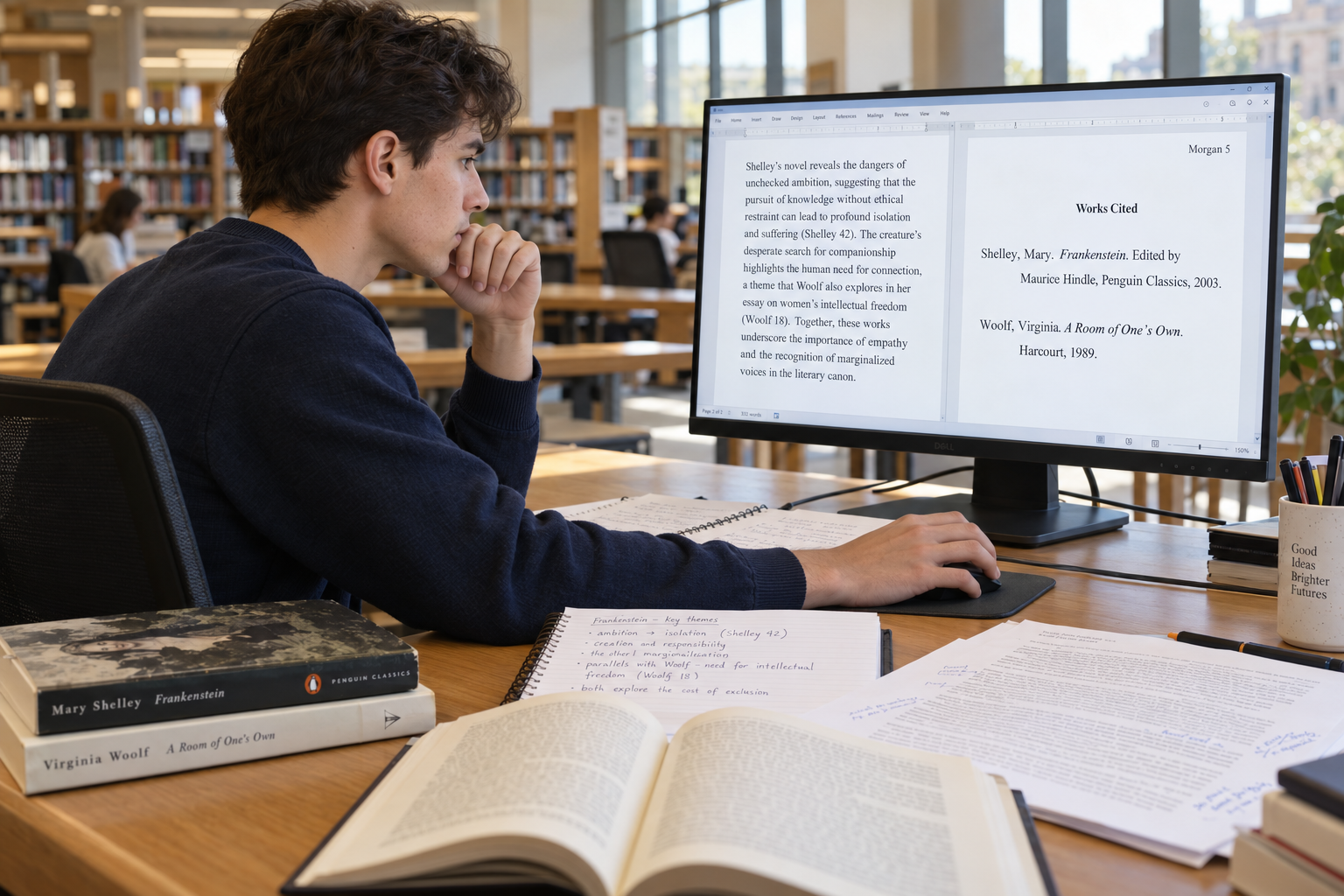
Academic citation does more than prevent plagiarism. It shows readers where evidence originated, separates a student's analysis from borrowed ideas, and provides enough information for sources to be located and checked. In subjects such as literature, languages, cultural studies, and other humanities disciplines, the Modern Language Association style is one of the most widely recognised systems for performing this task.
MLA 9, the ninth edition of the MLA Handbook, uses a flexible source-based approach rather than requiring students to memorise a completely different formula for every possible publication type. In-text citations normally direct readers to an entry in the Works Cited list, while the Works Cited entry records the publication information needed to identify the source. Understanding how those two parts work together is more useful than memorising isolated citation examples.
This MLA 9 citation guide explains the system step by step, including author-page citations, narrative citations, sources without page numbers, multiple authors, sources without named authors, books, journal articles, websites, and the Works Cited page. It also explains common MLA mistakes so that students can apply the style consistently when quoting, paraphrasing, and integrating research into academic assignments.
What Is MLA 9 Referencing?
MLA 9 is the citation and documentation system presented in the ninth edition of the MLA Handbook, published by the Modern Language Association of America in 2021. It is particularly associated with humanities subjects, where writers frequently analyse specific passages, texts, cultural works, and other primary and secondary sources. Unlike author-date systems, MLA in-text citations generally emphasise the author or another identifying element and, where available and relevant, a location such as a page number.
The system contains two closely connected components. An in-text citation appears at the point where a source is quoted, paraphrased, summarised, or otherwise used, while the Works Cited list provides the fuller bibliographic entry. The MLA Style Center's official overview of in-text citations explains that the in-text reference begins with the shortest information needed to direct the reader to the corresponding Works Cited entry.
This connection is fundamental. If the Works Cited entry begins with an author's surname, the in-text citation normally uses that surname. If the source has no author and the Works Cited entry begins with its title, the in-text citation uses the title or an appropriate shortened form of it instead.
MLA citations work as a navigation system: the in-text citation identifies the source briefly, and the Works Cited entry provides the fuller publication details.
How MLA 9 In-Text Citations Work
The standard MLA in-text citation for a paginated source commonly contains the author's surname followed by the relevant page number, with no comma between them. For example, a reference to information on page 45 of a work by an author named Smith would appear as (Smith 45). The author's name directs the reader toward the Works Cited entry, while 45 identifies the relevant location within that source.
If the author's name is already incorporated naturally into the sentence, repeating it inside parentheses is unnecessary. A sentence could therefore state that Smith argues a particular point and place only the page number in parentheses at the relevant location. This is often called a citation in prose or narrative citation, and it can make source integration more natural when the author's identity is important to the argument.
MLA citations should be placed where readers can understand exactly which information comes from the source. Epic Essay's guide to integrating in-text citations explains the broader importance of connecting source attribution clearly to the claim being supported. Citation placement should therefore create transparency without interrupting the academic argument unnecessarily.
The basic patterns can be compared as follows.
| Situation | Example | Explanation |
|---|---|---|
| Author not named in sentence | Reading practices change across digital environments (Smith 45). | Include surname and page number. |
| Author named in sentence | Smith argues that reading practices change across digital environments (45). | Include only the page number because the author is already identified. |
| Source without page numbers | Digital reading can alter patterns of attention (Smith). | Do not invent a page number. |
| No named author | The policy has been widely debated ("Digital Education"). | Use the title or an appropriate shortened title that directs readers to the Works Cited entry. |
The key principle is not to insert the same information mechanically into every citation. MLA citations adapt to the source. Include the information readers need to move unambiguously from the borrowed material to the correct Works Cited entry and, when relevant, to the appropriate location within that source.
How to Cite One, Two, or Three or More Authors in MLA 9
A source written by one author normally uses that author's surname in the parenthetical citation. If the author's name appears in the prose, only the relevant page or other location marker needs to appear parenthetically. This avoids unnecessary repetition while maintaining a clear connection to the Works Cited entry.
For a work by two authors, both surnames are normally included. A parenthetical reference might therefore take the form (Garcia and Patel 72). The Works Cited entry likewise records the authors according to MLA conventions, allowing the abbreviated in-text reference to lead readers to the full source information.
For a source by three or more authors, MLA uses the first author's surname followed by et al. in a parenthetical citation. This prevents citations from becoming excessively long. Students should ensure that the shortened in-text form corresponds clearly to the way the source begins in the Works Cited list.
| Authorship | Parenthetical Citation Example | Basic Approach |
|---|---|---|
| One author | (Smith 24) | Use the author's surname and page number where applicable. |
| Two authors | (Garcia and Patel 72) | Use both surnames. |
| Three or more authors | (Williams et al. 118) | Use the first author's surname followed by et al. |
These conventions keep the citation concise while preserving source identification. Students should also check for potential ambiguity, such as different authors sharing the same surname, because additional identifying information may sometimes be required to distinguish the sources clearly.
How to Cite Sources Without Page Numbers in MLA 9
Many digital sources do not have stable page numbers. Web articles, online reports, and dynamically displayed content may appear differently depending on the device or browser being used. MLA does not require students to invent page numbers for such material.
If a source has an author but no page or other appropriate part number, the author's surname may be sufficient in the parenthetical citation. If the author's name is already given in the prose and there is no page or part number to provide, an additional parenthetical citation may not be necessary because the reader already has the information required to locate the Works Cited entry.
Students should not use browser print-page numbers or estimate a location merely to make a citation resemble one for a printed book. The purpose of a locator is to help readers find the relevant material reliably. A location marker that exists only because of a particular screen or printing configuration can be misleading.
When a source provides another stable numbering system that MLA permits for that type of work, the relevant locator may be used. The broader principle remains consistent: provide meaningful source-location information when it exists and is appropriate, but never invent a page number simply because the source is being cited in MLA style.
How to Cite a Source with No Author in MLA 9
A source without a named author is normally entered in the Works Cited list under its title. The MLA Style Center specifically advises writers not to substitute "Anonymous" merely because no author is provided. The in-text citation should then direct the reader to that title rather than to a nonexistent author.
Long titles can be shortened in the in-text citation as long as the shortened form remains sufficient to identify the correct Works Cited entry. For example, an article titled "Digital Learning and the Changing University Classroom" might be shortened to ("Digital Learning") where no confusion with another source would result. The exact formatting of the title should follow MLA conventions for the type of work.
Before deciding that a source has no author, however, students should inspect it carefully. An organisation, government department, research institution, or other corporate body may be responsible for a publication even when no individual author appears. The source's actual authorship should be established rather than assumed from the absence of a personal name.
This principle also illustrates why citation software cannot replace source evaluation. A generator can process the metadata it receives, but it may not determine correctly who is responsible for a source. Students remain responsible for checking authorship and ensuring that the in-text citation corresponds to the Works Cited entry.
What Is the MLA 9 Works Cited Page?
The Works Cited page records the sources actually cited in the academic work. It normally begins on a new page after the main text and uses the heading Works Cited. Entries are organised alphabetically according to the element that begins each entry, usually the author's surname or, where there is no author, the title.
MLA uses a system of core elements to construct Works Cited entries. Rather than treating every source format as a completely unrelated citation formula, students identify the elements that apply to the source and arrange them according to MLA's prescribed order. The official MLA Works Cited quick guide explains this core-element approach and the important concept of containers.
A container is a larger work that contains the source being cited. A journal article, for example, is contained within a journal, while an individual webpage can be contained within a website. Some sources can have a second container, such as a journal article accessed through an academic database.
The core-element approach makes MLA flexible enough to document traditional books alongside digital and emerging sources. Students should record publication information while researching rather than attempting to reconstruct every citation immediately before submission.
How to Format an MLA 9 Works Cited Page
Works Cited formatting is part of MLA documentation, not an optional visual preference. Entries should be arranged alphabetically, and the list should use hanging indentation: the first line of an entry begins at the left margin while subsequent lines are indented. The Works Cited list is double-spaced under standard MLA paper formatting.
Students should also ensure that sources cited in the assignment have corresponding Works Cited entries. A citation that points to no identifiable entry prevents readers from locating the source. Conversely, an ordinary Works Cited list should represent works actually cited rather than becoming an unrelated list of everything consulted during research.
The following checklist captures the principal presentation features students should verify:
- Begin the Works Cited list on a separate page.
- Use the heading Works Cited.
- Arrange entries alphabetically according to MLA rules.
- Use hanging indentation for entries extending beyond one line.
- Double-space the Works Cited list when preparing an MLA-formatted paper.
- Ensure in-text citations correspond clearly to Works Cited entries.
- Apply MLA punctuation, capitalisation, and source-title conventions consistently.
Formatting should be checked alongside citation content. A perfectly indented entry can still be incorrect if the wrong author, publication date, container, or location has been supplied. Technical presentation and bibliographic accuracy therefore need to be reviewed together.
MLA 9 Works Cited Examples for Common Sources
The exact information required depends on the source. Books commonly require author, title, publisher, and publication year, while journal articles require details about the journal and may include volume, issue, page range, database, DOI, or another location. Online works often require the webpage title, website or container, publication information, and URL where appropriate.
The examples below demonstrate common MLA structures using sample bibliographic information. They are models for understanding the pattern rather than substitutes for checking the details of the actual source being cited.
| Source Type | Example MLA Structure |
|---|---|
| Book | Smith, Jordan. Academic Reading in the Digital Age. University Press, 2024. |
| Journal article | Patel, Maya. "Student Engagement in Hybrid Learning." Journal of Higher Education Research, vol. 18, no. 2, 2025, pp. 110-28. |
| Web article | Brown, Daniel. "How Digital Archives Are Changing Historical Research." Academic Research Network, 14 Mar. 2025, www.example.org/digital-archives. |
| Source with three or more authors | Williams, Robert, et al. Research and Learning in Higher Education. Academic Press, 2023. |
| Webpage without named author | "Understanding Digital Scholarship." Research Learning Centre, 2025, www.example.org/digital-scholarship. |
The punctuation and ordering are meaningful because they show how the source's components relate to one another. However, students should not copy an example blindly and replace a few words. They should identify which MLA core elements actually apply to the source in front of them.
How to Cite a Book in MLA 9
A basic book entry normally identifies the author, title, publisher, and publication year. For example, the pattern can be represented as: Author's Last Name, First Name. Title of Book. Publisher, Year. Additional elements are included where relevant, such as edition, translator, editor, or volume information.
The corresponding in-text citation normally uses the author's surname and relevant page number. If a student paraphrases an argument from page 86 of a book by Smith, the citation could appear as (Smith 86). If Smith is already named in the sentence, the parenthetical element can normally be reduced to (86).
Edited and translated books require additional attention because contributors may have an important role in identifying the version being used. A translation, for example, is not bibliographically identical to the work in its original language. Students should therefore record edition and contributor information while taking research notes.
This is particularly important in literary studies, where different editions can have different pagination. The Works Cited entry identifies the edition used, while the in-text citation directs the reader to the relevant location within that edition.
How to Cite a Journal Article in MLA 9
Journal articles usually require more publication information than books because the article exists within a larger periodical. A typical entry identifies the author, article title, journal title, volume, issue, publication date or year, and page range where applicable. For an article accessed online, a DOI, permalink, URL, or database information may also be relevant.
MLA treats the journal as the container holding the article. If the article was accessed through a database such as JSTOR, the database can function as an additional container. Understanding this structure makes complex citations easier to construct because students can see why different pieces of publication information appear in the entry.
Where an online scholarly article has a DOI, the DOI can provide a stable location. The MLA Style Center indicates a preference among online locations for a DOI, followed by a permalink and then a URL where applicable. Students should therefore inspect the article record carefully rather than automatically copying the browser address.
For in-text citation, the author and relevant page number are used when stable pagination exists. If the online article genuinely has no page or other suitable part numbers, students should not manufacture them. The in-text citation should still direct the reader clearly to the correct Works Cited entry.
How to Cite Websites and Online Sources in MLA 9
Online sources require the same fundamental question as print sources: what exactly is being cited? Students should generally cite the specific article, report, webpage, video, or other resource they used rather than treating an entire website as though it were one undifferentiated source. This produces a more precise and traceable citation.
A basic webpage entry can contain the author, title of the individual page, title of the website as container, publisher where appropriate, publication date, and URL. Not every source supplies every element. MLA's core-element approach allows students to include the information that genuinely applies rather than inventing missing details.
When an online source lacks a named individual author, students should investigate whether an organisation is responsible for it. If no author is appropriate, the Works Cited entry can begin with the source title. Epic Essay's guide to citing online academic sources provides additional discussion of the information students should collect when documenting material found online.
Students should also evaluate online material before citing it. The existence of a URL does not establish academic credibility. Authorship, publication responsibility, evidence quality, relevance, and the nature of the assignment should determine whether the source belongs in academic work.
How to Cite Quotations and Paraphrases in MLA 9
Direct quotations reproduce the source's wording and therefore require clear quotation formatting together with appropriate citation. For a short quotation from a paginated source, the author's surname and page number normally identify the source and location. The surrounding sentence should integrate the quotation grammatically and explain its relevance rather than allowing it to stand without analysis.
Paraphrasing changes the wording and structure of the source material but does not change ownership of the underlying idea. A paraphrased argument therefore still requires citation. Epic Essay's guide to paraphrasing and plagiarism explains why changing vocabulary without attribution does not make borrowed material original.
Students should also avoid excessive quotation. In many academic assignments, paraphrasing allows sources to be incorporated more smoothly into the student's own analytical framework. Quotations are most useful when the exact wording is itself important, particularly in textual analysis or when a source expresses an idea in language that requires direct examination.
A citation acknowledges where an idea came from; quotation marks identify borrowed wording. When using a direct quotation, students may need both.
Common MLA 9 Citation Mistakes Students Should Avoid
One common error is importing rules from another referencing style. MLA does not normally use the author-year pattern associated with APA or Harvard, so a citation such as (Smith, 2024) is not the standard MLA author-page form. Students who move between modules should check which style the assignment requires rather than relying on citation habits developed elsewhere.
Another frequent mistake is inserting page numbers into every citation even when the source has no stable pagination. Students may copy numbers generated by a PDF viewer, browser, or printed webpage without checking whether those numbers form part of the source itself. A locator should help another reader find the material reliably.
Mismatch between in-text citations and Works Cited entries is equally problematic. If the text cites Smith but no corresponding Smith entry appears in Works Cited, the documentation chain is incomplete. Students should conduct a final cross-check in both directions before submission.
Other recurring errors include inconsistent author names, incorrect treatment of source titles, missing container information, poorly constructed website citations, and trusting citation generators without checking their output. A citation generator can save time, but the student remains responsible for whether the final MLA citation is accurate.
A Step-by-Step MLA 9 Citation Checklist Before Submission
MLA accuracy is easier to maintain when referencing is treated as part of the research process rather than as final formatting. Recording bibliographic information while reading reduces the risk of losing authors, page numbers, publication dates, DOI information, and other details. It also makes it easier to distinguish direct quotations from paraphrased notes.
Before submitting an MLA-formatted assignment, students can use the following sequence:
- Confirm that MLA 9 is the referencing style required by the assignment.
- Check every quotation, paraphrase, summary, and source-specific idea for appropriate attribution.
- Ensure each in-text citation directs readers clearly to the corresponding Works Cited entry.
- Include page or other appropriate location information where it genuinely exists and is relevant.
- Check author treatment for one, two, and three or more authors.
- Verify the treatment of sources without authors or page numbers.
- Check each Works Cited entry against the actual source rather than relying solely on generated metadata.
- Arrange Works Cited entries according to MLA alphabetical conventions.
- Apply consistent hanging indentation and spacing to the final Works Cited page.
- Perform a final cross-check between every citation in the paper and the Works Cited list.
This final review should focus on consistency as well as individual correctness. A paper containing several different versions of the same author's name or inconsistent treatment of online sources can appear careless even when many entries are individually close to correct.
Using MLA 9 Citations Accurately in Academic Writing
MLA 9 becomes easier to use once students understand the relationship between the source, the in-text citation, and the Works Cited entry. The in-text citation should identify the source concisely and provide an appropriate locator where one exists, while the Works Cited entry supplies the fuller bibliographic information. Both components work together to make academic evidence transparent and traceable.
Accuracy also depends on adapting MLA principles to the source rather than forcing every source into the same formula. Books, journal articles, webpages, works without named authors, and unpaginated digital sources contain different information. The MLA core-element and container system provides a flexible framework for documenting those differences consistently.
For university assignments, the most reliable practice is to record source details during research, cite borrowed ideas as they enter the draft, and verify the final paper against current MLA 9 guidance before submission. When in-text citations and Works Cited entries are accurate and consistent, referencing becomes more than a formatting requirement: it provides a clear scholarly record of how evidence supports the student's academic argument.


Comments