
Original research does not require discovering a topic that nobody has ever studied. In most dissertations, theses, and research proposals, the researcher enters an established academic conversation and identifies something within that conversation that remains uncertain, insufficiently tested, contradictory, theoretically incomplete, or inadequately represented. That unresolved issue is the research gap, and it provides an important part of the justification for conducting a new study.
Finding a research gap is often difficult because students search for an entirely untouched topic. A genuine gap can exist even when hundreds of publications address the broader subject. Previous studies may concentrate on one population, repeatedly use the same method, produce conflicting findings, fail to test an important theoretical proposition, or establish evidence that has not translated effectively into practice.
This guide explains seven useful types of research gaps: evidence, knowledge, practical-knowledge, methodological, empirical, theoretical, and population gaps. These categories provide a practical framework rather than a universal taxonomy used identically in every discipline. More importantly, the guide shows how to identify a defensible gap from the literature and convert it into a precise gap statement that explains what is missing, why the omission matters, and how a proposed study can address it.
What Is a Research Gap?
A research gap is a specific limitation, unresolved question, inconsistency, or missing area within the existing body of knowledge that creates a justified opportunity for further investigation. The gap emerges from what the literature collectively shows rather than from the researcher's personal impression that a topic seems interesting. It therefore needs to be demonstrated through engagement with relevant and sufficiently current scholarship.
The literature review plays a central role in this process. Epic Essay's guide to literature review structure explains that a strong review moves from existing knowledge through synthesis and methodological evaluation toward identifiable limitations or omissions. This is also consistent with guidance from the Australian National University on structuring literature reviews, which describes the movement from what is well known toward what is less well known and ultimately to the research gap.
A gap should also be distinguished from a broad research problem. A problem statement explains the issue requiring investigation and why it matters, whereas the gap identifies the specific deficiency in existing knowledge that the proposed study can address. Epic Essay's problem statement guide explains how evidence of a problem, the knowledge gap, and the significance of the issue work together when establishing the rationale for research.
A research gap is not simply something that has not been studied. It is something important that the existing evidence does not yet explain, test, resolve, or represent adequately.
How Do You Find a Genuine Research Gap?
A defensible gap normally emerges through synthesis rather than from reading one article. Researchers need to compare studies across themes, populations, theories, methods, settings, and findings. The James Madison University Writing Center similarly describes literature reviews as a process of evaluating and synthesising relevant scholarship in order to arrive at a research gap, question, or direction for further investigation.
One useful strategy is to create a literature matrix recording each study's research question, population, setting, theoretical framework, methodology, major findings, and limitations. Patterns then become easier to see. If nearly every study uses cross-sectional questionnaires, for example, a methodological limitation may emerge; if results repeatedly disagree despite examining similar relationships, the literature may contain an evidence gap.
Researchers should also examine the limitations and future-research sections of recent studies and systematic reviews, but these recommendations should not simply be copied. An author's suggestion for future research indicates a possible direction, not proof that the gap still exists. Subsequent studies may already have addressed the issue, so the proposed gap must be checked against the broader and more recent literature.
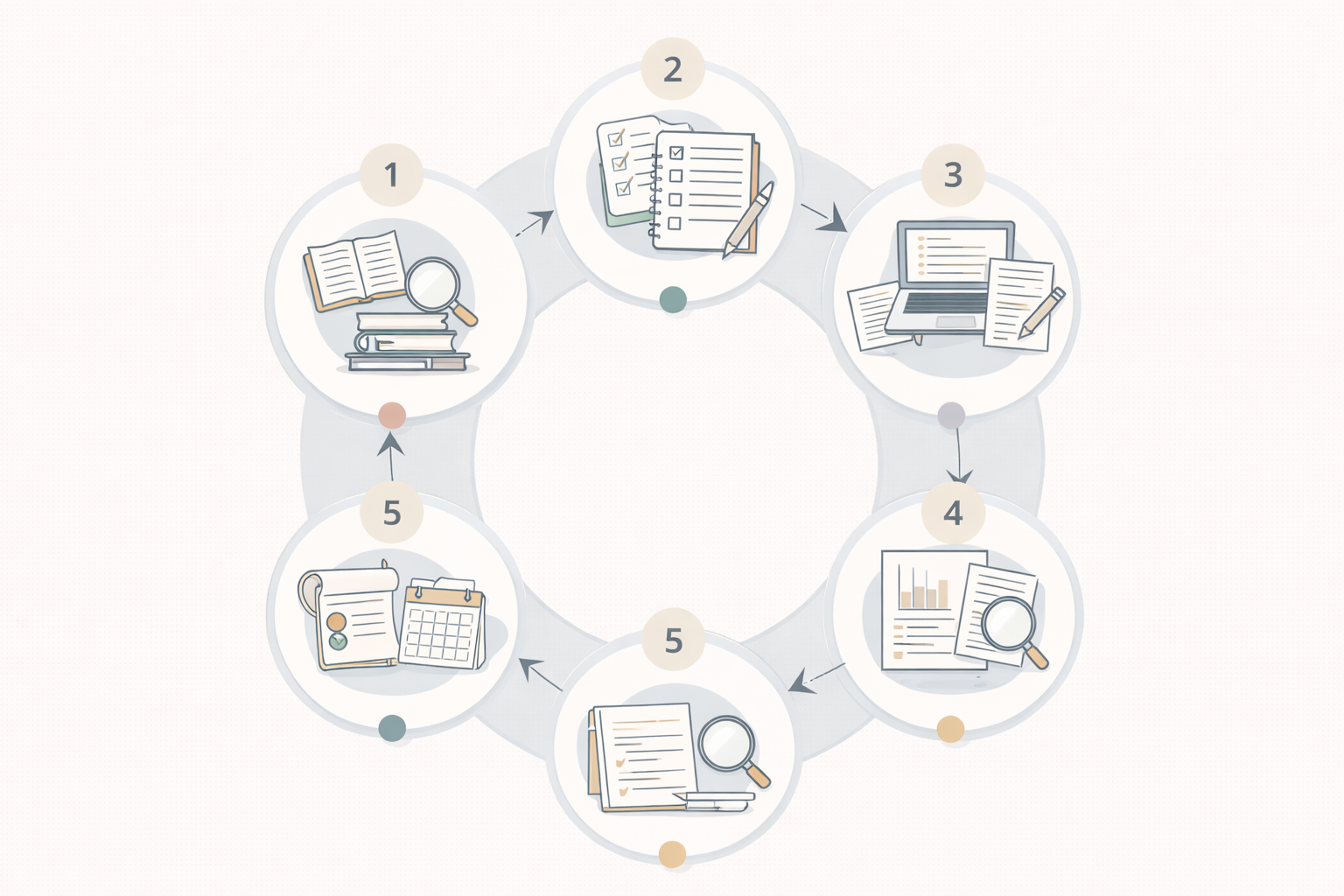
A systematic search for a research gap can therefore proceed through the following stages:
- Define the research area and its central concepts precisely.
- Search recent and foundational academic literature using several relevant keyword combinations.
- Organise studies according to themes, methods, populations, theories, contexts, and findings.
- Compare what studies consistently establish with what remains uncertain or contested.
- Examine limitations and recommendations without accepting them uncritically.
- Search specifically for studies that might already have addressed the suspected gap.
- Evaluate whether the remaining gap is important, researchable, and feasible within the proposed study.
The final verification stage is particularly important. A failed database search does not prove that a research gap exists. The apparent absence may result from narrow keywords, unsuitable databases, language restrictions, or unfamiliar terminology. A credible gap statement should therefore be based on sufficiently broad engagement with the relevant literature.
Seven Types of Research Gaps with Examples
Research-gap terminology is not completely standardised across disciplines. Some frameworks combine categories that others separate, and labels such as contextual, geographical, temporal, and population gaps may overlap depending on the study. One useful seven-part framework distinguishes evidence, knowledge, practical-knowledge, methodological, empirical, theoretical, and population gaps.
The categories should be treated as analytical tools rather than boxes into which every dissertation must fit. A single research project may contain more than one type of gap. For example, an understudied population may also have been investigated only through one methodological approach, creating both population and methodological limitations.
| Research Gap Type | What Is Missing or Unresolved? | Core Question |
|---|---|---|
| Evidence gap | Existing findings are inconsistent or contradictory | Why does the available evidence disagree? |
| Knowledge gap | Important knowledge about a phenomenon remains insufficient | What do we still not adequately understand? |
| Practical-knowledge gap | Research knowledge and actual practice do not align | Why is established knowledge not reflected in practice? |
| Methodological gap | Existing methods limit what can be concluded | What might a different or stronger method reveal? |
| Empirical gap | A proposition or relationship lacks sufficient empirical testing | What claim still requires observation or testing? |
| Theoretical gap | Existing theory inadequately explains the phenomenon | What theoretical explanation remains incomplete? |
| Population gap | An important population is absent or underrepresented | Whose experiences or outcomes remain insufficiently studied? |
The distinctions in Table 1 help researchers explain why further investigation is necessary rather than merely declaring that "few studies exist." The strength of the gap comes from identifying the specific deficiency in the evidence and showing how that deficiency affects what researchers can currently conclude.
1. Evidence Gap: When Previous Studies Produce Conflicting Findings
An evidence gap occurs when existing studies provide findings that cannot easily be reconciled. One group of studies may report a positive relationship between two variables while another reports no meaningful relationship or an effect in the opposite direction. The gap is therefore not an absence of research but uncertainty created by the research already available.
Consider studies investigating whether remote working improves employee productivity. Some may report productivity gains associated with greater autonomy and reduced commuting, while others identify lower productivity where collaboration, home working conditions, or managerial support are weak. A new study could investigate whether organisational support or occupation helps explain these apparently inconsistent findings.
A useful gap statement would identify the disagreement explicitly rather than saying that "more research is needed." It might explain that existing studies report inconsistent relationships between remote working and productivity and that the conditions under which these relationships change remain insufficiently understood. The proposed study can then investigate a plausible moderator, mechanism, or contextual explanation.
2. Knowledge Gap: When an Important Question Remains Unanswered
A knowledge gap exists when the literature does not provide sufficient understanding of an important aspect of a phenomenon. Research may exist on the broader subject while leaving one mechanism, relationship, outcome, or dimension poorly understood. This is different from claiming that absolutely nothing has been published on the topic.
For example, substantial research may examine students' use of generative AI, but comparatively less may explain how students evaluate the reliability of AI-generated academic information before using it. The knowledge gap concerns a specific process within a heavily researched broader topic. A study could therefore investigate students' verification strategies rather than repeating another general survey of AI adoption.
Strong knowledge gaps are narrow enough to investigate. Statements such as "little is known about social media" are too broad to establish a useful research direction. The researcher needs to specify exactly which relationship, mechanism, outcome, or experience remains insufficiently understood and support that assessment with the reviewed literature.
3. Practical-Knowledge Gap: When Research and Practice Do Not Match
A practical-knowledge gap appears when established research knowledge and observed professional practice are disconnected. Evidence may recommend particular practices, interventions, or procedures, yet organisations or practitioners may implement them inconsistently or not at all. Research can then investigate the reasons for the difference between evidence and practice.
For example, educational research may support regular formative feedback as a means of improving student learning, while students in a particular higher-education context report receiving feedback too late to use it in subsequent assignments. The gap is not simply whether feedback is effective. It concerns why an evidence-supported practice is not being implemented in a way consistent with what the literature recommends.
This form of gap is particularly useful in applied disciplines such as education, healthcare, management, social work, and public policy. However, researchers must demonstrate both sides of the gap: what credible evidence recommends and what evidence indicates is happening in practice. Without that comparison, the claimed theory-practice divide can become an unsupported assumption.
4. Methodological Gap: When Existing Research Uses Limited Methods
A methodological gap occurs when the methods dominating existing research restrict what researchers can know about a phenomenon. The issue is not that previous researchers used a particular method incorrectly. Instead, repeated dependence on one design, data source, measurement strategy, or analytical approach may leave important dimensions of the research problem inaccessible.
Imagine that most studies of doctoral student wellbeing rely on one-time self-report questionnaires. These studies may identify associations between workload, supervision, and wellbeing, but cross-sectional surveys provide limited evidence about how wellbeing changes throughout candidature. A longitudinal design could therefore address a methodological limitation by observing changes over time.
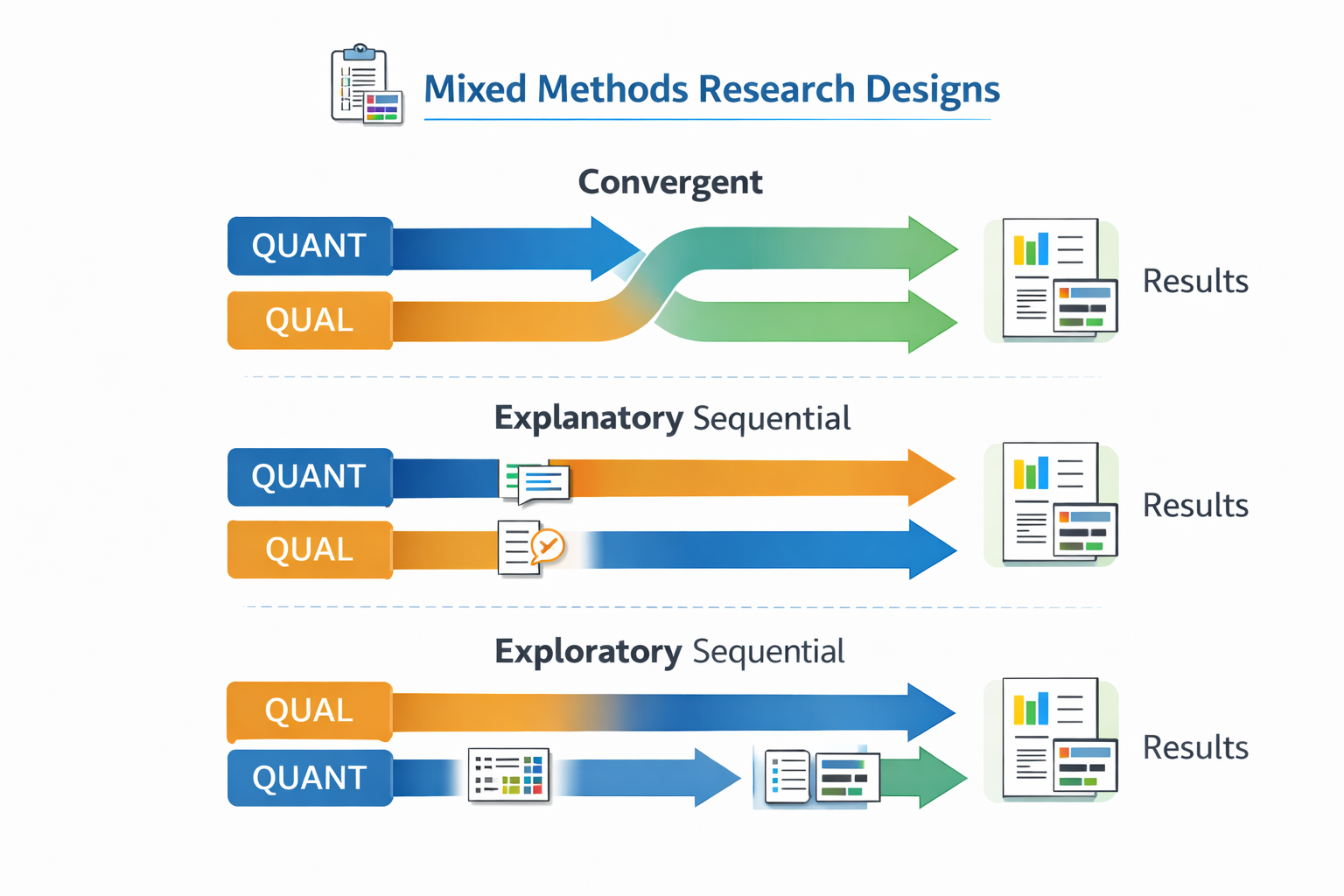
Likewise, quantitative studies may establish the prevalence of an outcome without explaining participants' experiences of the processes producing it. Qualitative interviews or an appropriately designed mixed-methods study could provide a different form of evidence. The justification, however, must explain what the alternative method makes possible rather than claiming that a method is valuable merely because previous researchers did not use it.
A methodological gap is strongest when the proposed method addresses a limitation in what previous methods could reveal, not simply when it is different from them.
5. Empirical Gap: When a Claim Still Needs Direct Testing
An empirical gap concerns a proposition, relationship, assumption, or theoretical expectation that lacks sufficient direct observation or testing. Existing scholarship may discuss the relationship conceptually or infer it indirectly, yet appropriate empirical evidence remains limited. A new study can address the gap by collecting and analysing evidence capable of testing the proposition more directly.
For example, theoretical literature may propose that perceived algorithmic transparency increases consumer trust in automated financial advice. If the proposition is frequently discussed but rarely tested using data from actual users, an empirical gap remains. A researcher could design a study measuring transparency perceptions and trust or experimentally manipulate the information participants receive about the system.
An empirical gap should not be confused with a general knowledge gap. The defining feature is the need for observation, measurement, or testing of a proposition that already has some conceptual basis. The gap statement should therefore identify both the existing claim and the evidence that remains necessary to evaluate it.
6. Theoretical Gap: When Existing Theory Does Not Fully Explain the Phenomenon
A theoretical gap arises when available theories or conceptual frameworks provide an incomplete explanation of the phenomenon being studied. Existing research may apply one theoretical perspective repeatedly while neglecting mechanisms that another framework could illuminate. Alternatively, observed findings may challenge predictions derived from the dominant theory.
For example, research on university students' adoption of educational technology might concentrate on perceived usefulness and ease of use while paying less attention to social identity, institutional trust, or academic norms. A researcher could investigate whether another theoretical perspective explains variation that the dominant framework leaves unresolved.
Simply applying a famous theory to a new dataset does not automatically establish a theoretical gap. The researcher must explain what existing theoretical explanations cannot adequately account for and why the proposed framework could advance understanding. The contribution lies in improving explanation, extending theory, comparing theoretical predictions, or clarifying theoretical boundaries.
7. Population Gap: When Important Groups Are Underrepresented
A population gap occurs when particular groups are absent, underrepresented, or inadequately differentiated within existing research. Findings derived predominantly from one population may not automatically apply to another population whose experiences, characteristics, or circumstances differ in theoretically relevant ways.
Suppose most research on workplace digital surveillance examines permanent employees in large organisations. Little evidence may address temporary platform workers whose employment relationships, bargaining power, and exposure to algorithmic monitoring differ substantially. Studying that population could address a meaningful gap if there are sound reasons to expect those differences to matter.
Geographical and contextual gaps can overlap with population gaps but require similar caution. The fact that no study was located in one city, university, or country is not automatically a strong research justification. The researcher needs to explain why characteristics of that setting could plausibly affect the phenomenon and why findings from existing populations cannot simply be assumed to transfer unchanged.
How to Write a Strong Research Gap Statement
A research gap statement should emerge after the literature has established what is already known. Epic Essay's literature review example guide demonstrates the importance of comparing findings, evaluating methodological limitations, and moving from synthesis toward unresolved questions. The gap statement is therefore the outcome of the literature review's reasoning rather than an isolated sentence added at the end.
A strong gap statement normally performs four connected functions. It establishes what the literature already demonstrates, identifies the precise limitation or unresolved issue, explains why that limitation matters, and indicates how the present study responds. These functions can appear across several sentences rather than being compressed artificially into one sentence.
The structure can be represented as follows:
| Component | Question to Answer | Purpose |
|---|---|---|
| Established knowledge | What does existing research already show? | Demonstrates command of the literature |
| Specific gap | What remains unresolved, limited, or underrepresented? | Identifies the deficiency precisely |
| Significance | Why does this missing knowledge matter? | Explains why the gap deserves investigation |
| Research response | How will the proposed study address it? | Connects the gap to the study's purpose |
This structure prevents a common problem in which students identify an absence but never explain its significance. A gap becomes academically persuasive when the reader can understand both what is missing and what becomes difficult to explain, predict, evaluate, or implement because of that missing knowledge.
Research Gap Statement Examples: Weak vs Strong
The difference between weak and strong gap statements is usually specificity and evidence. Weak statements rely on sweeping claims such as "no research exists" or "few researchers have studied this topic." Stronger statements identify the relevant literature, specify its limitation, and explain the consequence of that limitation.
The examples below are illustrative rather than claims about actual bodies of literature. Their purpose is to demonstrate how the wording of a gap statement can move from a vague assertion to a researchable academic justification.
| Gap Type | Weak Statement | Stronger Gap Statement |
|---|---|---|
| Evidence | Studies disagree about remote working. | Existing studies report inconsistent relationships between remote working and employee productivity, while the organisational conditions that may explain these differences remain insufficiently examined. |
| Knowledge | Not much is known about students and AI. | Although student adoption of generative AI has received growing attention, less is understood about how students evaluate the reliability of AI-generated academic information before incorporating it into assessed work. |
| Methodological | Previous studies used surveys, so interviews are needed. | Existing studies rely predominantly on cross-sectional self-report surveys, limiting understanding of how participants interpret and experience the process underlying the observed statistical relationships. |
| Theoretical | No one has used this theory before. | Existing explanations emphasise individual utility perceptions but provide limited explanation of the social and institutional mechanisms associated with adoption, leaving the theoretical account incomplete. |
| Population | No study has been conducted at this university. | Existing evidence is derived primarily from large metropolitan universities, leaving students in smaller resource-constrained institutions underrepresented despite contextual differences that may influence the phenomenon. |
The stronger examples avoid claiming novelty merely because a particular location, method, or population has not appeared in the researcher's initial search. Instead, each example explains what the existing evidence cannot currently establish. That explanation creates the logical bridge between literature review and proposed research.
How to Turn a Research Gap into Research Questions and Objectives
Once the gap is clear, the research question should follow logically from it. If the identified gap concerns contradictory findings, the question may investigate conditions explaining the disagreement. If the gap concerns an underrepresented population, the research question should examine the relevant phenomenon within that population rather than merely describe the group.
The research objectives should then specify the tasks required to answer the question. Epic Essay's research proposal outline guide shows how the problem statement, research aims and questions, literature review, and methodology need to function as connected components. A research gap that does not lead naturally to feasible research questions usually requires further refinement.
Consider a methodological gap in which existing research on student engagement consists primarily of cross-sectional surveys. If the important limitation is an inability to understand how engagement changes during an academic year, the research question could focus explicitly on change over time. The methodology would then need a longitudinal component capable of generating the evidence that the gap requires.
This alignment provides a useful test of gap quality. The researcher should be able to explain the sequence clearly: existing scholarship establishes a body of knowledge; a particular limitation remains; that limitation produces a specific unanswered question; and the chosen methodology generates evidence capable of addressing that question.
Common Research Gap Mistakes to Avoid
The most serious mistake is declaring that "no research exists" without conducting a sufficiently broad search. Absolute novelty claims are difficult to establish and are often unnecessary. A dissertation can make a valuable contribution by resolving uncertainty, testing an established idea in a meaningful context, improving a method, or extending understanding of an underrepresented population.
A second mistake is confusing a location difference with an academic gap. Saying that a topic has never been studied at University X does not explain why University X should produce theoretically or practically different findings. Context becomes a meaningful gap only when the researcher can demonstrate why features of that context matter to the phenomenon.
Students also sometimes construct a gap from one article's limitations section. A published author may recommend studying another population or method, but that recommendation needs verification against subsequent and wider scholarship. The University of Leeds guidance on literature reviews emphasises synthesis, selective evidence, and showing how limitations in previous work create a gap rather than relying on isolated observations.
Finally, a gap can be genuine but too large for the proposed project. Statements such as "the long-term effects of artificial intelligence on society remain unknown" may be defensible at a broad level but cannot guide a manageable dissertation. A useful research gap must be both academically significant and realistically addressable by the study being proposed.
How to Build a Defensible Research Gap for Your Dissertation
A strong research gap begins with synthesis rather than novelty claims. Researchers should establish what the literature already knows, compare how that knowledge was produced, identify where findings or explanations become incomplete, and verify that recent research has not already resolved the suspected gap. The seven gap types provide useful lenses for this analysis, but the evidence should determine the category rather than the category determining what the researcher claims to have found.
The final gap statement should then be precise enough to guide the study. It should identify the relevant existing knowledge, specify what remains unresolved, explain why the limitation matters, and show how the proposed research can address it. When those elements are connected, the gap becomes more than a sentence in the literature review; it becomes the intellectual justification for the research design.
For dissertation and thesis writing, the most reliable question is therefore not "What has nobody studied before?" but "What can the existing evidence not yet explain or establish adequately?" Answer that question through careful literature synthesis, narrow the unresolved issue to something feasible, and connect it directly to the research question and methodology. A research gap developed in this way gives the study a clear academic purpose and a defensible contribution.
Comments