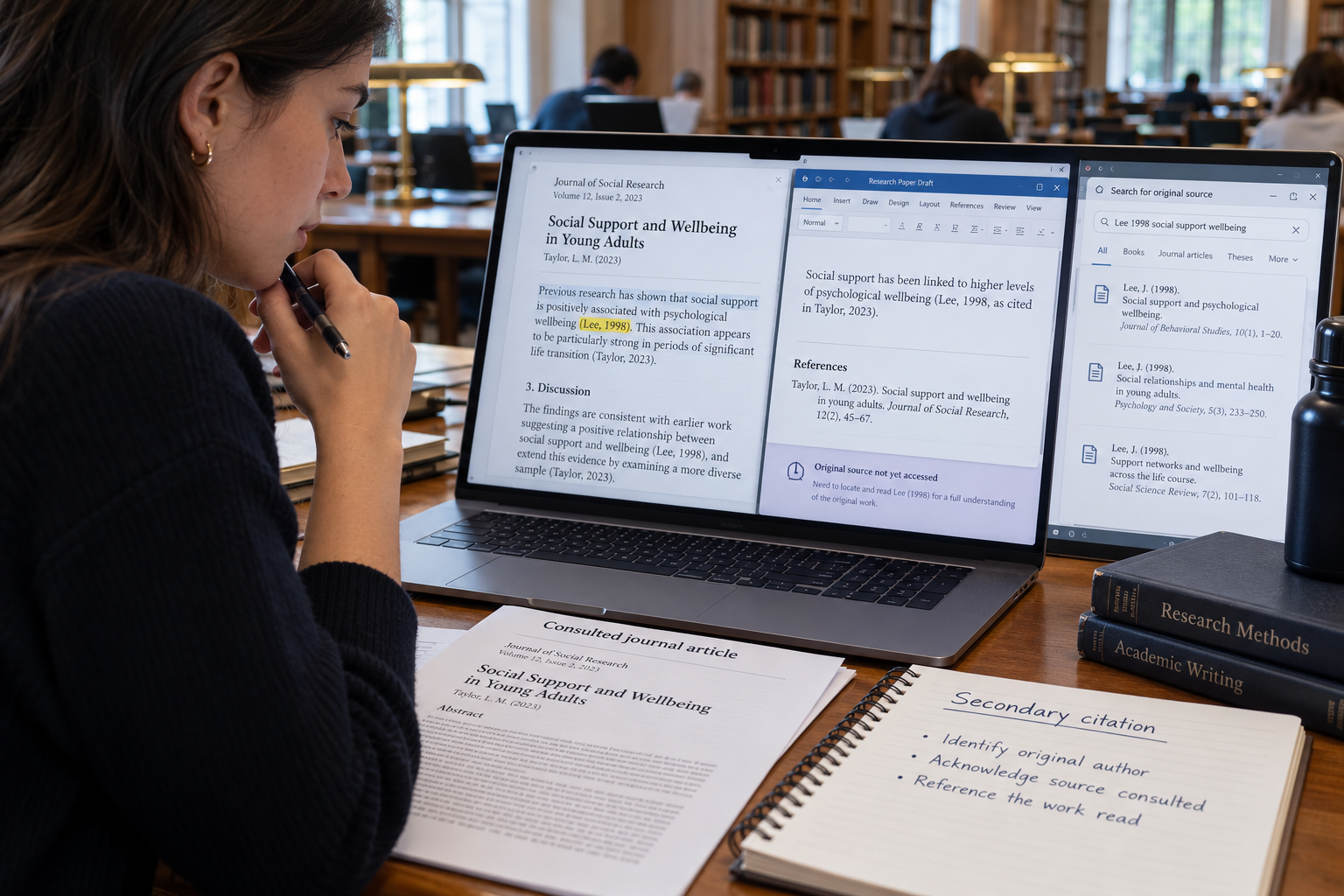
Academic research often leads students from one source to another. You may read a recent journal article that discusses an influential study published decades earlier, find a textbook quoting a theorist whose original book is unavailable, or encounter an important historical argument through a systematic review. The difficulty begins when you want to use that original idea but have not actually read the work in which it first appeared.
Secondary referencing provides a transparent way to handle this situation. It tells the reader that an idea originated with one author but that your knowledge of it comes from another source you actually consulted. This distinction matters because citing the original work as though you had read it can misrepresent your research process and prevent you from knowing whether the secondary author has interpreted the original accurately.
However, secondary referencing should usually be an exception rather than the normal way of building an academic argument. Students should make a reasonable effort to locate important original sources, especially when those sources are central to a dissertation, theoretical framework, or critical claim. This guide explains how secondary referencing works, when it is justified, how it differs in Harvard and APA 7, what belongs in the reference list, and how to avoid the mistakes that commonly occur when citing a source found in another source.
What Is Secondary Referencing?
Secondary referencing occurs when you refer to an original author's ideas, findings, or words even though you encountered them through another publication rather than reading the original work yourself. The original publication is commonly described as the primary or original source for that particular claim, while the publication you actually read functions as the secondary source through which you discovered it.
For example, imagine that a 2024 journal article by Patel discusses a theory originally proposed by Morgan in 1985. You have access to Patel's article but cannot obtain Morgan's original publication. If Morgan's idea is relevant to your assignment, your citation needs to make clear that you know about Morgan's argument through Patel rather than from direct consultation of the 1985 work.
This principle is consistent with the broader rules discussed in Epic Essay's guide to academic citation rules, which explains that secondary referencing is generally discouraged when the original source can reasonably be accessed. The issue is not that every secondary citation is academically unacceptable. The issue is transparency about what you have and have not read.
Never create the impression that you personally consulted an original source when your knowledge of that source comes entirely from another author's discussion of it.
Primary Sources and Secondary Sources in a Secondary Citation
The terminology can initially seem confusing because "primary source" and "secondary source" have broader meanings that vary by discipline. In historical research, for example, a primary source might be an archival letter, while a secondary source might be a historian's analysis. In secondary referencing, the distinction is narrower: it concerns the source of the specific idea you are trying to cite and the publication through which you encountered it.
Suppose Wilson published an influential model in 1992 and Ahmed's 2023 article discusses that model. If you read Ahmed but not Wilson, Wilson is the original source for the model and Ahmed is your secondary source. Your citation needs to acknowledge both roles without implying direct access to Wilson.
The distinction becomes easier when the sources are separated by function, as shown below.
| Element | Original Source | Secondary Source |
|---|---|---|
| Role | Contains the idea, theory, finding, or quotation in its original context | Discusses or reproduces material from the original source |
| Have you read it? | No, in a genuine secondary citation | Yes |
| Example | Wilson (1992) | Ahmed (2023) |
| What can you verify directly? | Only what the secondary source reports about it | The content of the secondary source itself |
| Reference-list treatment | Depends on referencing style, but commonly not listed when it was not consulted | Normally included because this is the work actually read |
The most important principle is traceability. Your reader should be able to tell which publication you personally used and therefore which source supports your representation of the original author's work.
Why Should You Find the Original Source Whenever Possible?
Reading the original source allows you to evaluate the author's argument in its proper context. A secondary author may summarise only the part relevant to their own argument, omit qualifications, simplify a complex theoretical position, or interpret the original work from a particular perspective. Relying entirely on that interpretation gives you less control over the evidence.
Direct consultation also improves critical analysis. If an important theory forms the foundation of your dissertation, reading the original publication enables you to examine how the concept was defined, what evidence supported it, what limitations the author acknowledged, and whether later scholars represent it accurately. This is considerably stronger than repeating a short summary encountered elsewhere.
There is also a practical risk of citation errors being transmitted through academic literature. Publication dates, page numbers, quotations, names, and even interpretations can be reproduced incorrectly. Accessing the original source gives you an opportunity to verify those details instead of repeating another author's mistake.
Epic Essay's guide to academic referencing similarly recommends using secondary references sparingly and consulting original works where possible. This is especially important when a source is central rather than incidental to your argument.
When Is Secondary Referencing Appropriate?
Secondary referencing becomes reasonable when an original source cannot realistically be consulted but its contribution remains relevant to your argument. An older book may be out of print, an archival source may be inaccessible, a publication may exist in a collection unavailable to your institution, or an original document may be written in a language you cannot responsibly interpret.
It can also be useful when discussing the historical development of a concept and a reliable modern source reproduces or explains an inaccessible foundational work. In such cases, the secondary citation allows you to acknowledge the original intellectual contribution while remaining honest about the source through which you encountered it.
Convenience alone is a weaker justification. If the original journal article can be located through your university library, DOI, Google Scholar, publisher database, institutional repository, or another legitimate source, it is normally preferable to retrieve and read it. This is particularly important for evidence that carries substantial weight in your argument.
A useful rule is therefore to ask whether you made a reasonable effort to find the original and whether the claim is important enough to justify further searching. Secondary referencing is a solution to genuine access limitations, not a shortcut for avoiding source retrieval.
How to Cite a Secondary Source in Harvard Referencing
Harvard referencing is not controlled by one universal manual, so secondary-citation formatting can vary between universities. Some institutional Harvard systems use expressions such as "cited in" or "cited by," while others specify slightly different punctuation and ordering. Your own university's referencing guide should therefore take priority over a generic example.
A common Harvard pattern makes both the original author and the source actually read visible. Using fictional authors for illustration, an indirect citation might appear as: "Morgan's early model emphasised the role of social interaction in learning (Morgan, 1985, cited in Patel, 2024)." A narrative version could state: "Morgan (1985, cited in Patel, 2024) proposed that..."
The logic matters more than memorising the example. Morgan receives intellectual credit for the original idea, while Patel tells the reader where you actually encountered Morgan's work. You should then follow your institution's rules regarding which details appear in the reference list.
Epic Essay's Harvard referencing examples explain that Harvard is a family of author-date systems rather than one completely standardised style. Secondary referencing is one of the areas where checking your university's specific Harvard guide is particularly important.
How to Cite a Secondary Source in APA 7
APA 7 uses the expression "as cited in" when the original work has not been read directly. Suppose a student reads Brown's 2022 work, which discusses a theory developed by Carter in 1978. The secondary citation identifies Carter as the original source while showing that Brown is the source actually consulted.
A parenthetical example would be: "(Carter, 1978, as cited in Brown, 2022)." In a narrative construction, the student could write: "Carter (1978, as cited in Brown, 2022) argued that..." These examples are illustrative, so the names and dates should never be copied into a real assignment unless they correspond to genuine sources.
Under APA's secondary-source approach, the work actually read is the one included in the reference list. If you read Brown but did not read Carter, Brown is therefore the reference-list entry. Epic Essay's APA 7 in-text citation guide illustrates this rule and likewise recommends using secondary citations only when the original work is unavailable.
This creates an important distinction between intellectual attribution and bibliographic access. The in-text citation acknowledges both Carter and Brown, but the reference list directs readers to the work you actually consulted.
Harvard vs APA Secondary Referencing
Harvard and APA share the same underlying principle: readers should be able to recognise that you did not consult the original work directly. However, their preferred wording and exact formatting can differ. Harvard also varies between institutions, whereas APA is governed by a defined publication style.
The comparison below shows the general logic using fictional sources. It should be adapted to the specific referencing guide required for your assignment.
| Feature | Harvard | APA 7 |
|---|---|---|
| Typical linking phrase | Often "cited in" or a university-specified variation | "as cited in" |
| Illustrative citation | (Morgan, 1985, cited in Patel, 2024) | (Morgan, 1985, as cited in Patel, 2024) |
| Original author acknowledged in text? | Yes | Yes |
| Source actually read identified? | Yes | Yes |
| Reference-list rule | Follow the institution's Harvard variant | List the secondary source actually read |
| Preferred practice | Consult the original where reasonably possible | Consult the original where reasonably possible |
Students using Harvard should pay particular attention to their university's guide because punctuation, wording, and reference-list treatment can differ. The safest practice is not to convert an APA example into Harvard simply by changing "as cited in" to "cited in" without checking the required local convention.
Which Source Goes in the Reference List?
This is one of the most common sources of confusion in secondary referencing. The reference list is designed to help readers identify the material you actually consulted. Consequently, many major citation systems require the secondary source you read to appear in the reference list rather than a publication you never accessed.
For example, suppose you read Patel's 2024 article discussing Morgan's 1985 work but never obtained Morgan's publication. Your in-text citation can acknowledge Morgan as the originator of the idea while making Patel's intermediary role clear. The reference list should then follow the rules of your citation style for the work actually consulted.
Adding a full reference for Morgan based solely on details copied from Patel can create the misleading impression that you personally retrieved Morgan's publication. It can also reproduce bibliographic errors if Patel's reference list contains a mistake. This is why the distinction between citation and reference-list entry matters.
Do not build a reference-list entry for an unread original source merely to make your bibliography appear more extensive. Follow the rules of your required style and represent your actual source use accurately.
How to Cite a Direct Quote Found Inside Another Source
Direct quotations require additional care because you are reproducing exact words attributed to an original author without having inspected the original publication yourself. Ideally, locate the original source and verify the wording, punctuation, context, and relevant page number before quoting it. This removes uncertainty about whether the secondary author reproduced the passage accurately.
If the original cannot be accessed and your style permits indirect quotation, the citation must still make the secondary relationship clear. You should follow your required style's rules for locators rather than guessing a page number from the original. The page you can verify directly is normally the location in the work you actually read.
This distinction matters because an original page number copied from another author's citation has not been independently verified by you. If exact wording is not essential, paraphrasing the secondary author's account may sometimes be academically safer and clearer than reproducing a quotation at second hand.
Epic Essay's guide to in-text citations and source integration explains that page numbers are important when quoting directly and that citation format depends on the referencing system being used. With secondary quotations, students need to satisfy those normal quotation rules while also making indirect access transparent.
Secondary Referencing vs Paraphrasing: What Is the Difference?
Secondary referencing describes your relationship to the source, while paraphrasing describes how you express information from a source. They therefore solve different problems. You can paraphrase an idea and still need a secondary citation if you never read the original work from which that idea came.
Imagine that Patel summarises Morgan's theory in several paragraphs. You rewrite the concept completely in your own words but still attribute the idea to Morgan. Because your understanding of Morgan comes through Patel, changing the wording does not transform Morgan into a source you have personally consulted.
The same principle applies to plagiarism. Paraphrasing removes the need for quotation marks when genuinely expressed in your own words, but it does not remove the need for attribution. Epic Essay's guide to common referencing mistakes identifies missing citations for paraphrased ideas as a frequent academic error.
Students should therefore ask two separate questions: "Whose idea is this?" and "Which publication did I actually read?" Secondary referencing answers the second question while accurate attribution addresses the first.
Can You Use Secondary Referencing in a Dissertation?
Secondary references can appear in a dissertation, but they should normally be used selectively. Dissertation research is expected to demonstrate substantial engagement with relevant literature, and repeatedly relying on other scholars' descriptions of foundational works can weaken the depth of that engagement. This is especially true when the original publications are easily obtainable.
A small number of justified secondary citations may be entirely reasonable. Historical texts can be genuinely inaccessible, specialist archival materials may not be obtainable, and some original works may exist in languages or formats beyond the researcher's legitimate access. Transparency is more academically responsible than pretending those sources were read.
The importance of the source should influence how much effort you make to retrieve it. If an original theory forms the conceptual foundation of an entire dissertation, relying solely on one later author's summary is difficult to justify when the original can reasonably be found. If the source supports a minor historical observation, indirect citation may be less consequential.
Secondary referencing should therefore remain proportional to its role in the dissertation. It is a legitimate scholarly mechanism for acknowledging indirect access, not a replacement for a thorough literature search.
How to Decide Whether to Use a Secondary Citation
Before creating a secondary reference, pause and assess whether indirect citation is genuinely necessary. Many sources that initially appear inaccessible can now be found through university databases, DOI searches, institutional repositories, library catalogues, interlibrary loan services, or legitimate author archives.
A useful decision process is:
- Identify the original author, year, title, and other available publication details.
- Search your university library catalogue and subscribed academic databases.
- Search the DOI or exact publication title where appropriate.
- Check legitimate institutional or subject repositories.
- Determine whether an accessible version of the original work exists.
- If you find it, read the relevant material before citing the original directly.
- If you cannot reasonably access it, confirm that your referencing style permits secondary citation.
- Make the indirect relationship explicit in your in-text citation.
- Reference the source you actually read according to the required style.
This process improves both source quality and academic honesty. It also prevents secondary referencing from becoming an automatic response whenever one article mentions another.
What If You Find the Original Source After Writing a Secondary Citation?
If you later obtain and read the original work, you are no longer dependent on the secondary author's account for the material you have verified. You can normally revise the passage to cite the original source directly, provided the claim you make is genuinely supported by what you read.
Do not simply replace the secondary citation with the original author's name without checking the text. The secondary author may have paraphrased, narrowed, extended, or interpreted the original argument. Reading the source may reveal that your existing sentence needs substantive revision rather than only a citation change.
You may also decide that both sources deserve citation for different reasons. For example, the original publication may establish the theory, while the later source offers a contemporary interpretation or application. In that situation, you are citing two works you have actually read rather than using one as a secondary route to the other.
This distinction strengthens literature-review writing because it separates historical intellectual origins from later scholarly development. It can also support more sophisticated comparison instead of presenting theories as though they have remained unchanged since their original publication.
Can You Cite a Source Mentioned in a Systematic Review?
Systematic reviews frequently summarise dozens or hundreds of primary studies, making them valuable for understanding the overall evidence base. However, reading a review does not mean you have personally read every study included within it. If you want to make a detailed claim about one particular study, retrieving that study is normally preferable.
If your argument concerns the review's synthesis, cite the systematic review itself. For example, if a review concludes that the evidence across multiple studies is inconsistent, that synthesis belongs to the review authors. You do not need to transform every included study into a secondary citation.
The situation changes when you specifically want to attribute a finding to one original study described by the review. If that study is inaccessible and your referencing rules permit indirect citation, secondary referencing may be appropriate. However, the citation should make your indirect access clear.
This distinction prevents a common problem in literature reviews: citing individual studies as though they had been independently evaluated when the student has actually relied entirely on another review's summary.
What If Several Secondary Sources Discuss the Same Original Author?
Finding several authors who discuss the same foundational work does not automatically remove the need to locate the original. In fact, differences among those interpretations can make direct consultation even more important. One scholar may emphasise a theoretical mechanism while another focuses on a methodological implication.
If the original remains inaccessible, you can discuss how the accessible authors interpret it, provided your wording makes that relationship clear. In such a case, your analysis may appropriately focus on the later literature rather than claiming direct knowledge of the original author's complete position.
Multiple secondary accounts can also reveal how a theory has developed over time. This can be academically valuable in its own right. The key is to distinguish what the original author is reported to have argued from what later scholars themselves conclude.
Clear attribution prevents layers of scholarship from collapsing into a single claim. Readers should be able to tell whether a statement represents an original theory, a later interpretation, or your own synthesis of several accessible sources.
Common Secondary Referencing Mistakes Students Make
The most serious mistake is citing the original author directly despite never reading the original source. If you encountered Morgan's work only through Patel but write "(Morgan, 1985)" without indicating Patel, the reader reasonably assumes that you consulted Morgan. That misrepresents the evidence underlying your writing.
A second mistake is placing every author in the reference list regardless of which publications were actually read. Reference lists are not collections of names encountered during research. They are structured records governed by the citation style being used.
Another mistake is overusing secondary citations when original publications are readily available. A literature review filled with "cited in" or "as cited in" constructions can suggest that the researcher has relied on other scholars' interpretations rather than engaging directly with important literature.
Finally, students sometimes mix referencing systems. They may use APA's "as cited in" wording while otherwise following a university-specific Harvard system, or apply a generic Harvard example despite their institution prescribing another format. Epic Essay's Harvard referencing guide stresses that institutional Harvard variations should be followed consistently.
Secondary Referencing Examples for Common Academic Situations
The easiest way to understand indirect citation is to distinguish different research situations. The examples below use fictional authors and should be adapted to the required referencing style rather than copied as real references.
| Situation | Recommended Approach | Reason |
|---|---|---|
| A recent article cites an older article available through your library | Retrieve and read the older article | The original can reasonably be consulted |
| A textbook quotes an inaccessible historical publication | Consider a secondary citation if permitted | Direct access may be genuinely impractical |
| A systematic review summarises an accessible study you want to discuss in detail | Read the individual study | You are making a study-specific claim |
| A review provides a synthesis of 40 studies | Cite the review for its synthesis | The synthesis is the review authors' contribution |
| A modern author interprets a classic theorist differently from another scholar | Cite the modern interpretations you actually read and seek the original where possible | The interpretations are themselves analytically relevant |
| You found the original after initially citing it secondarily | Read it and revise the citation where appropriate | You can now verify the original claim directly |
The central decision is not whether secondary referencing is technically possible. The stronger question is whether it is the most transparent and academically defensible way to support the particular claim you are making.
How to Write About an Original Author Without Overclaiming
Your sentence structure should reflect the evidence you actually possess. If you have only a secondary account, avoid making sweeping claims about everything the original author believed. Your accessible source may discuss only one aspect of a much broader argument.
For example, saying "Morgan's entire theory is based on..." would be difficult to defend if you have never read Morgan. A narrower statement such as "Morgan's model is described by Patel as emphasising..." can more accurately represent your evidential position when that wording suits the required citation style and argument.
This principle becomes especially important in critical writing. You cannot confidently criticise an original author's methodology, limitations, definitions, or assumptions if all you have seen is a brief summary written by someone else. Retrieve the original before making detailed evaluative claims whenever reasonably possible.
Secondary sources can still be valuable because scholarly interpretation is itself part of academic debate. The mistake is not reading later scholarship; it is confusing later scholars' representations of an original work with direct knowledge of that work.
A Step-by-Step Checklist for Secondary Referencing
Before submitting an assignment, review every indirect citation and ask whether it represents your source use accurately. This is particularly important in dissertations and literature reviews, where a large number of citations can make secondary-source errors difficult to notice during final proofreading.
Use the following checklist:
- Identify which author originally produced the idea, finding, theory, or quotation.
- Identify the publication through which you actually encountered it.
- Make a reasonable attempt to locate the original source.
- Read the original directly if it is accessible and relevant to your argument.
- If it remains inaccessible, check whether your required referencing style permits secondary citation.
- Use the exact secondary-citation format required by your university or style guide.
- Make it clear in the text that your access to the original was indirect.
- Do not invent bibliographic details or page numbers for the original source.
- Follow the correct reference-list rule for the style you are using.
- Be especially cautious with direct quotations encountered second hand.
- Avoid building central theoretical arguments entirely from secondary citations.
- Check that every reference-list entry corresponds with your actual source use.
This approach keeps the research trail transparent. It also encourages stronger source selection by making secondary referencing a deliberate decision rather than an unnoticed habit.
Using Secondary Referencing Accurately in Academic Writing
Secondary referencing is a legitimate way to acknowledge an original author when your knowledge of that author's work comes through another source. Its central purpose is transparency: the original scholar receives appropriate intellectual credit while the reader can see which publication you actually consulted. Harvard commonly uses institution-specific forms such as "cited in," while APA 7 uses "as cited in."
The strongest academic practice is still to retrieve and read important original sources whenever reasonably possible. Direct consultation gives you access to context, definitions, limitations, evidence, and nuances that a secondary author's summary may not preserve. It is particularly important when the original work forms a major part of your theoretical framework or critical argument.
When the original genuinely cannot be obtained, secondary referencing is preferable to pretending that you read it. Follow your required style carefully, reference the material you actually consulted as instructed by that style, and keep indirect citations selective. Accurate secondary referencing is ultimately less about punctuation than academic honesty: your citations should allow readers to see clearly where your knowledge came from and how directly you engaged with the evidence.



Comments