Understanding the difference between summarising and paraphrasing is essential for academic success. University students are expected to engage critically with scholarly sources, integrate evidence smoothly, and maintain academic integrity. However, many students struggle to distinguish when to summarise, when to paraphrase, and how each technique affects the strength of their argument.
Although summarising and paraphrasing both involve restating information in your own words, they serve different purposes. Confusing them can lead to weak analysis, misrepresentation of ideas, or even unintentional plagiarism. This guide explains the conceptual and practical differences between summarising and paraphrasing, provides examples, and outlines best practices for academic writing.
What Is Summarising in Academic Writing?
Summarising involves condensing a larger body of text into its core ideas. The purpose is to present only the most important points while omitting detailed explanations, examples, and secondary arguments. A summary is significantly shorter than the original text.
A summary captures the main idea and key points of a source in a much shorter form.
Summarising is useful when introducing background information, outlining the general position of an author, or reviewing literature broadly. It demonstrates your ability to identify essential arguments without reproducing unnecessary detail.
Example of Summarising
Original (100+ words): A study examines the impact of social media on student academic performance, exploring positive aspects such as collaboration and resource sharing, as well as negative effects including distraction and reduced concentration.
Summary: Research indicates that social media has both beneficial and detrimental effects on student academic performance (Author, Year).
The summary removes specific details and retains only the central idea.
What Is Paraphrasing in Academic Writing?
Paraphrasing involves restating a specific idea or passage in your own words while maintaining approximately the same level of detail. Unlike summarising, paraphrasing does not significantly shorten the content. Instead, it restructures the idea while preserving meaning.
Paraphrasing restates an idea fully but in new wording and structure.
Paraphrasing is particularly useful when you need to analyse or integrate a specific concept without directly quoting the source. It allows your academic voice to remain dominant while still acknowledging scholarly evidence.
Example of Paraphrasing
Original: “Excessive social media use can interfere with students’ ability to maintain sustained attention during academic tasks.”
Paraphrased: High levels of social media engagement may disrupt students’ capacity to focus consistently on their academic responsibilities (Author, Year).
This version maintains detail but changes wording and structure.
Key Differences Between Summarising and Paraphrasing
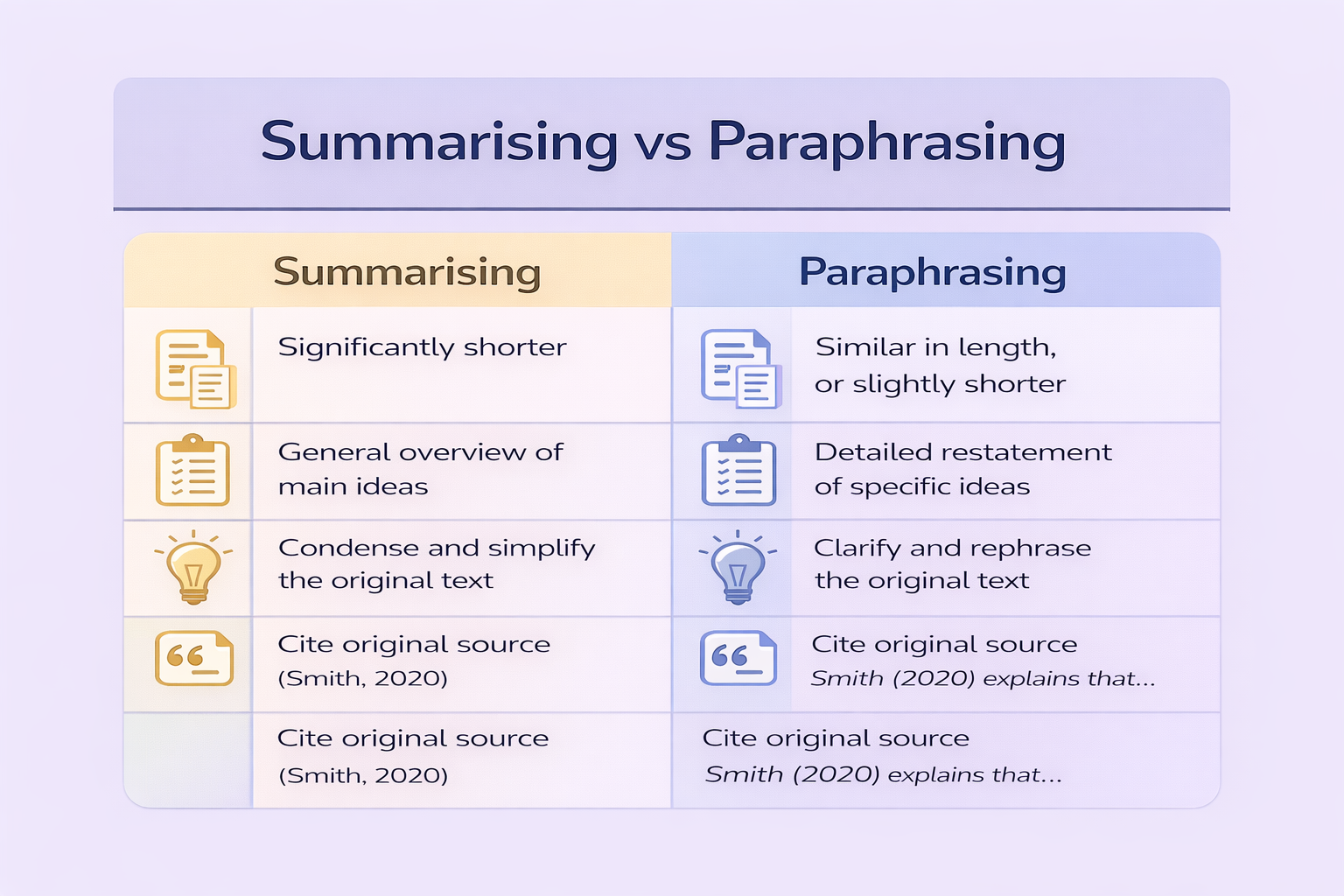
The distinction between summarising and paraphrasing becomes clearer when compared systematically.
| Feature | Summarising | Paraphrasing |
|---|---|---|
| Length | Much shorter than original | Similar length to original |
| Level of Detail | Only main points | Full detail retained |
| Purpose | Provide overview | Integrate specific idea |
| Structural Change | Significant condensation | Structural rewording |
| Citation Required | Yes | Yes |
This comparison highlights that while both techniques require citation, they serve different rhetorical functions in academic writing.
When to Use Summarising
Summarising is appropriate in the following contexts:
- Providing background information in introductions.
- Reviewing multiple studies in literature reviews.
- Condensing long theoretical explanations.
- Outlining an author's overall position.
In literature reviews, for example, summarising helps synthesize multiple studies efficiently without overwhelming the reader with excessive detail.
When to Use Paraphrasing
Paraphrasing is more suitable when:
- You need to explain a specific theory or finding.
- You want to analyse or critique a detailed argument.
- You aim to maintain a consistent academic tone.
- You wish to avoid excessive direct quotation.
Paraphrasing allows deeper engagement because it demonstrates comprehension rather than surface-level reporting.
Common Mistakes Students Make
Students often confuse summarising and paraphrasing, leading to academic weaknesses.
- Producing overly long summaries that resemble paraphrases.
- Paraphrasing by changing only a few words.
- Failing to cite after summarising or paraphrasing.
- Misrepresenting the original meaning.
Even when using your own words, citation is always required.
Neglecting citation remains one of the most serious academic errors.
How Both Techniques Strengthen Academic Voice
Both summarising and paraphrasing contribute to academic voice when used strategically. Summarising demonstrates your ability to synthesise broad ideas. Paraphrasing shows analytical engagement and conceptual understanding.
Effective academic writing typically combines both techniques. For instance, a paragraph may begin with a summary of several studies, followed by a paraphrased explanation of one key finding that supports your argument.
Integrating Summaries and Paraphrases Effectively
Integration requires careful signal phrases and transitions. For example:
Several researchers argue that digital literacy significantly influences academic achievement (Author, Year). One study further suggests that students with structured digital training demonstrate improved research skills (Author, Year).
The first sentence summarises a general trend. The second paraphrases a specific finding. This combination enhances clarity and coherence.
Mastering the Difference Between Summarising and Paraphrasing
Recognising the difference between summarising and paraphrasing is a foundational academic skill. Summarising condenses ideas to their essentials, while paraphrasing restates detailed content in new language. Both techniques require comprehension, structural transformation, and proper citation.
By understanding when and how to use each method, students can improve analytical depth, maintain originality, and strengthen their academic writing. Mastery of these techniques not only prevents plagiarism but also elevates scholarly credibility and intellectual authority.
Comments