Academic writing is one of the most demanding skills university students are expected to master. Unlike informal or creative writing, academic writing follows strict conventions designed to support clarity, precision, and intellectual accountability. These conventions apply across disciplines, even though subject-specific expectations may vary.
Understanding academic writing fundamentals is therefore essential for academic success. This article explains the core principles that underpin academic writing, why they matter within higher education, and how students can apply them effectively in assessed work.
What Academic Writing Is and Why It Exists
Academic writing is a formal mode of communication used to present ideas, arguments, and evidence within scholarly contexts. Its primary purpose is not self-expression but the clear, logical transmission of knowledge that can be evaluated, questioned, and built upon by others.
Universities rely on academic writing as an assessment tool because it demonstrates a student’s ability to think critically, engage with evidence, and communicate ideas systematically. These skills are central to higher education and professional research cultures.
When students misunderstand the purpose of academic writing, they often adopt inappropriate styles that weaken credibility and reduce marks.
Definition: Academic writing is structured, evidence-based communication that prioritises clarity, precision, and critical engagement over personal opinion.
Clarity and Precision as Foundational Principles
Clarity is one of the most important academic writing fundamentals. Academic texts are assessed not only on what they say but on how clearly ideas are communicated. Ambiguous phrasing, vague terminology, or poorly defined concepts make arguments difficult to follow.
Precision supports clarity by ensuring that terms are used consistently and accurately. In academic contexts, small differences in wording can significantly alter meaning, particularly when discussing theories, methodologies, or findings.
Examiners reward writing that allows complex ideas to be understood without unnecessary effort.
Argument-Driven Writing Rather Than Description
At university level, writing is expected to be argumentative rather than purely descriptive. Description explains what exists, while argument explains why it matters, how it functions, or what it implies. Many students struggle to move beyond description, particularly in early undergraduate study.
An academic argument is a position that responds directly to a question and is supported through reasoning and evidence. Without a clear argument, essays tend to become collections of information rather than coherent responses.
Argument-driven writing demonstrates higher-order thinking and is a key differentiator between lower and higher grades.
Structured Organisation of Ideas
Structure is central to academic writing because it guides the reader through complex reasoning. Well-structured writing signals control over material and respect for the reader’s cognitive load.
Academic structure operates at multiple levels, including the overall essay, individual sections, and paragraphs. Each level should contribute logically to the central argument.
Poor structure often results in repetition, irrelevant content, or underdeveloped analysis.
Core Structural Expectations
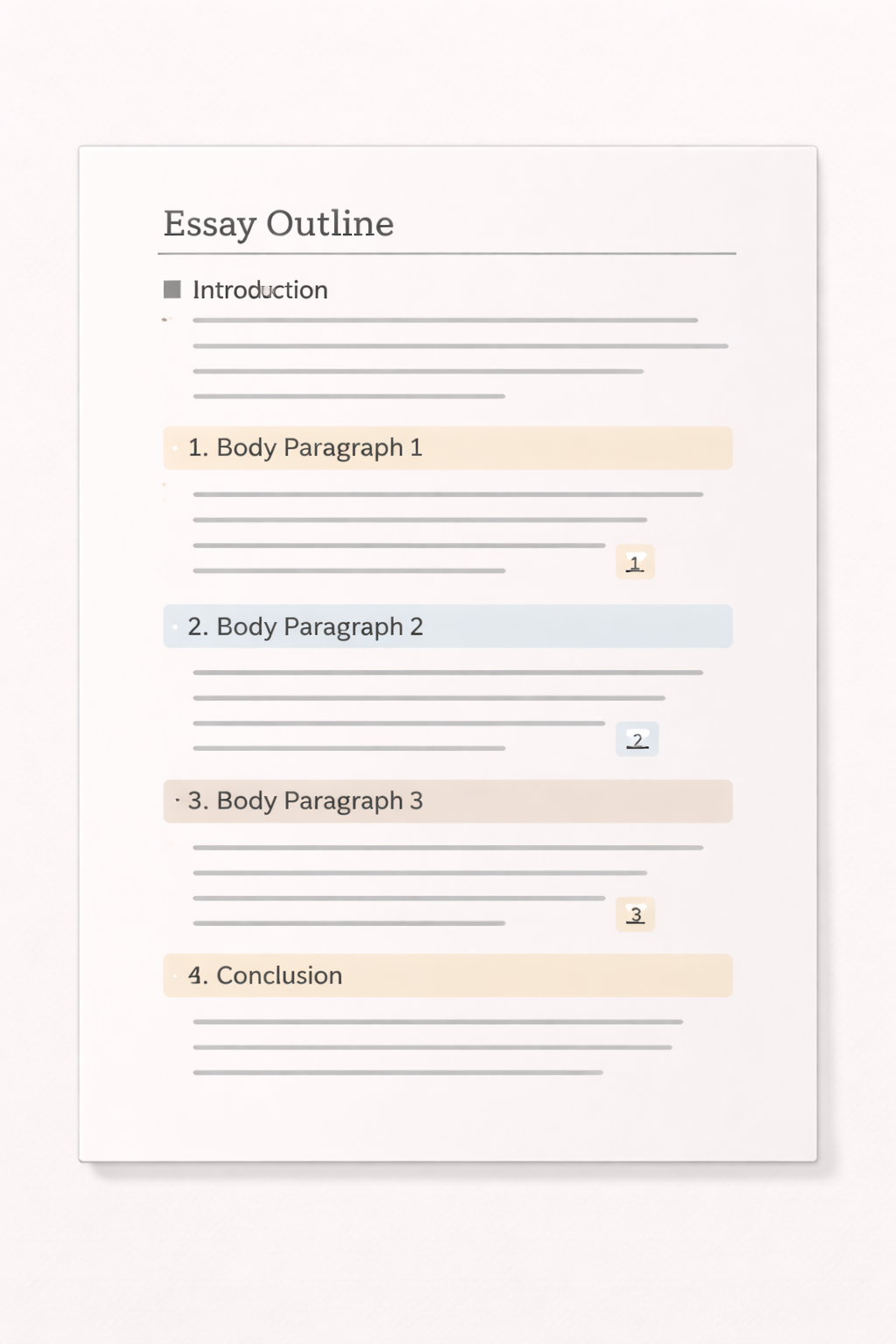
- A focused introduction that establishes purpose and direction
- Body paragraphs organised around distinct analytical points
- A conclusion that synthesises rather than repeats content
Structural awareness is a fundamental marker of academic maturity.
Paragraph Discipline and Cohesion
Paragraphs are the building blocks of academic writing. Each paragraph should develop a single idea that supports the overall argument. When paragraphs attempt to cover multiple ideas, clarity and analytical depth are lost.
Effective paragraphs typically begin with a clear topic sentence, followed by explanation, evidence, and analytical commentary. This internal logic allows the reader to follow reasoning without confusion.
Paragraph cohesion also depends on clear links between ideas, ensuring the essay progresses logically rather than appearing fragmented.
Evidence Use and Academic Integrity
Evidence is central to academic writing because it grounds arguments in existing scholarship. However, evidence must be used strategically rather than excessively. Simply inserting citations does not demonstrate understanding.
Strong academic writing introduces evidence, explains its relevance, and critically engages with its implications. This shows that the writer understands not only what sources say but why they matter.
Academic integrity requires that all sources are acknowledged accurately and consistently.
Examiner expectation: Evidence should support your argument, not replace your own analytical voice.
Academic Tone and Objectivity
Academic tone reflects objectivity, caution, and professionalism. This does not mean writing should be dull or impersonal, but it should avoid emotional language, informal expressions, and unsupported claims.
Objectivity is achieved through balanced reasoning, acknowledgement of limitations, and careful phrasing. Absolute statements are rarely appropriate in academic contexts.
Maintaining academic tone enhances credibility and demonstrates awareness of scholarly conventions.
Consistency in Style and Terminology
Consistency is an often-overlooked academic writing fundamental. Inconsistent terminology, shifting tense, or uneven formatting disrupt the reading experience and suggest lack of control.
Academic writing benefits from stable terminology, consistent referencing style, and uniform presentation. These elements allow readers to focus on content rather than form.
Minor inconsistencies may not fail an essay, but they cumulatively reduce perceived quality.
Revision as an Academic Skill
Revision is not merely proofreading for errors; it is a critical academic process. Effective revision involves reassessing structure, argument strength, and clarity before addressing surface-level issues.
Many students underestimate the value of revision, submitting drafts that could be significantly improved with focused review. Academic writing improves through iteration, not speed.
Examiners can usually distinguish between drafted and revised work.
Common Fundamental Errors and Their Consequences
When academic writing fundamentals are ignored, predictable problems arise. These errors often lead to lower grades despite strong subject knowledge.
| Error | Academic Consequence |
|---|---|
| Lack of clear argument | Essay appears descriptive and unfocused |
| Poor paragraph structure | Weak logical flow and reduced clarity |
| Inconsistent referencing | Reduced credibility and integrity concerns |
Recognising these patterns allows students to correct them proactively.
Applying Academic Writing Fundamentals Across Disciplines
Although disciplines differ in methodology and style, academic writing fundamentals remain consistent. Whether writing in humanities, social sciences, or STEM fields, clarity, structure, and evidence remain central.
Students who master these fundamentals can adapt more easily to discipline-specific expectations. This flexibility is particularly important in interdisciplinary programmes.
Strong foundational skills support academic development at all levels of study.
Developing Long-Term Academic Writing Confidence
Academic writing confidence develops through understanding, practice, and reflection. Students who view writing as a skill rather than a talent are more likely to improve consistently.
By mastering academic writing fundamentals, students gain control over their work and reduce anxiety around assessments. Writing becomes a structured process rather than a source of uncertainty.
These skills extend beyond university into professional and research contexts.
Mastering Academic Writing Fundamentals for Sustainable Success
Academic writing fundamentals provide the foundation upon which all strong university work is built. They support clear thinking, rigorous argumentation, and effective communication.
Students who internalise these principles are better equipped to meet assessment criteria and engage confidently with complex ideas. Mastery is achieved through deliberate practice and critical self-review.
Strong academic writing is not accidental; it is the result of disciplined, informed application of fundamental principles.



Comments