Poetry analysis is one of the most challenging tasks students encounter in literature courses. Unlike prose, poetry compresses meaning into dense language, sound, and structure, which increases the risk of misinterpretation and superficial analysis.
Many students lose marks not because they misunderstand the poem entirely, but because they fall into predictable poetry analysis mistakes. These errors often involve description instead of analysis, unsupported claims, or a lack of focus on language. This article examines the most common mistakes in poetry analysis and provides practical guidance on how to avoid them in essays and exams.
Why Poetry Analysis Is Commonly Misunderstood
Poetry requires a different analytical mindset from other forms of writing. Students accustomed to summarising novels or historical texts often attempt the same approach with poetry, which rarely succeeds.
Examiners expect students to interpret how meaning is created, not simply what happens in the poem. When this expectation is unclear, analysis becomes vague, repetitive, or descriptive.
Mistake 1: Summarising the Poem Instead of Analysing It
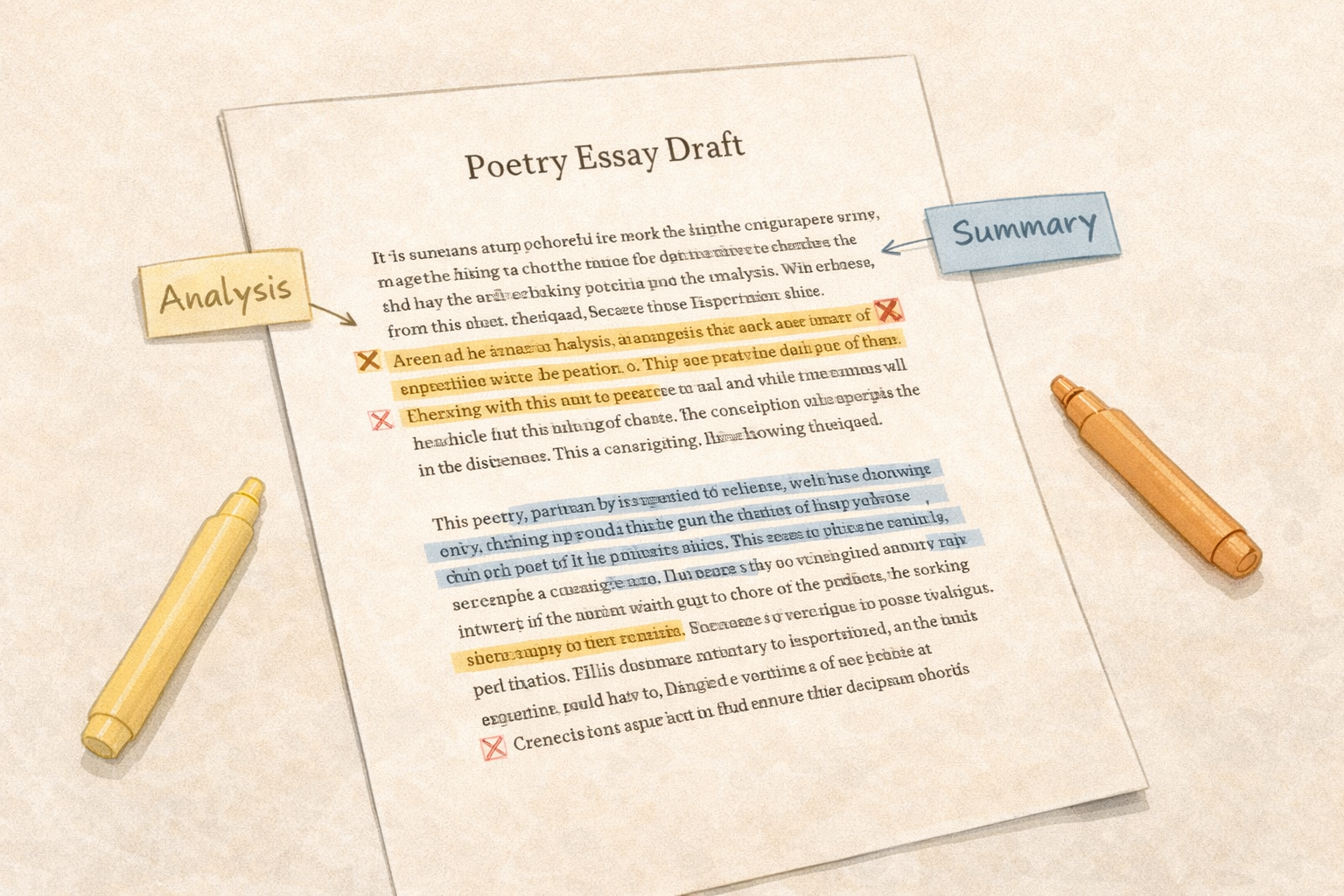
One of the most frequent poetry analysis mistakes is excessive summary. Students often retell what the poem describes rather than analysing how it conveys meaning.
While brief contextual reference is sometimes necessary, extended paraphrase signals a lack of analytical engagement and limits the depth of interpretation.
Academic rule: Summary explains what happens in a poem; analysis explains how and why it happens.
Mistake 2: Treating Poetry as Personal Opinion
Another common error is approaching poetry analysis as a purely subjective exercise. Students sometimes believe that any interpretation is acceptable if it reflects their feelings.
In academic contexts, interpretations must be supported by textual evidence. Personal responses are valid only when they are grounded in close reading of language and form.
Mistake 3: Ignoring Language and Focusing Only on Themes
Many students correctly identify themes but fail to analyse how the poem develops them. Naming a theme without explaining its construction is a significant analytical weakness.
Strong poetry analysis demonstrates how diction, imagery, and structure work together to express thematic ideas.
Mistake 4: Quoting Without Explaining
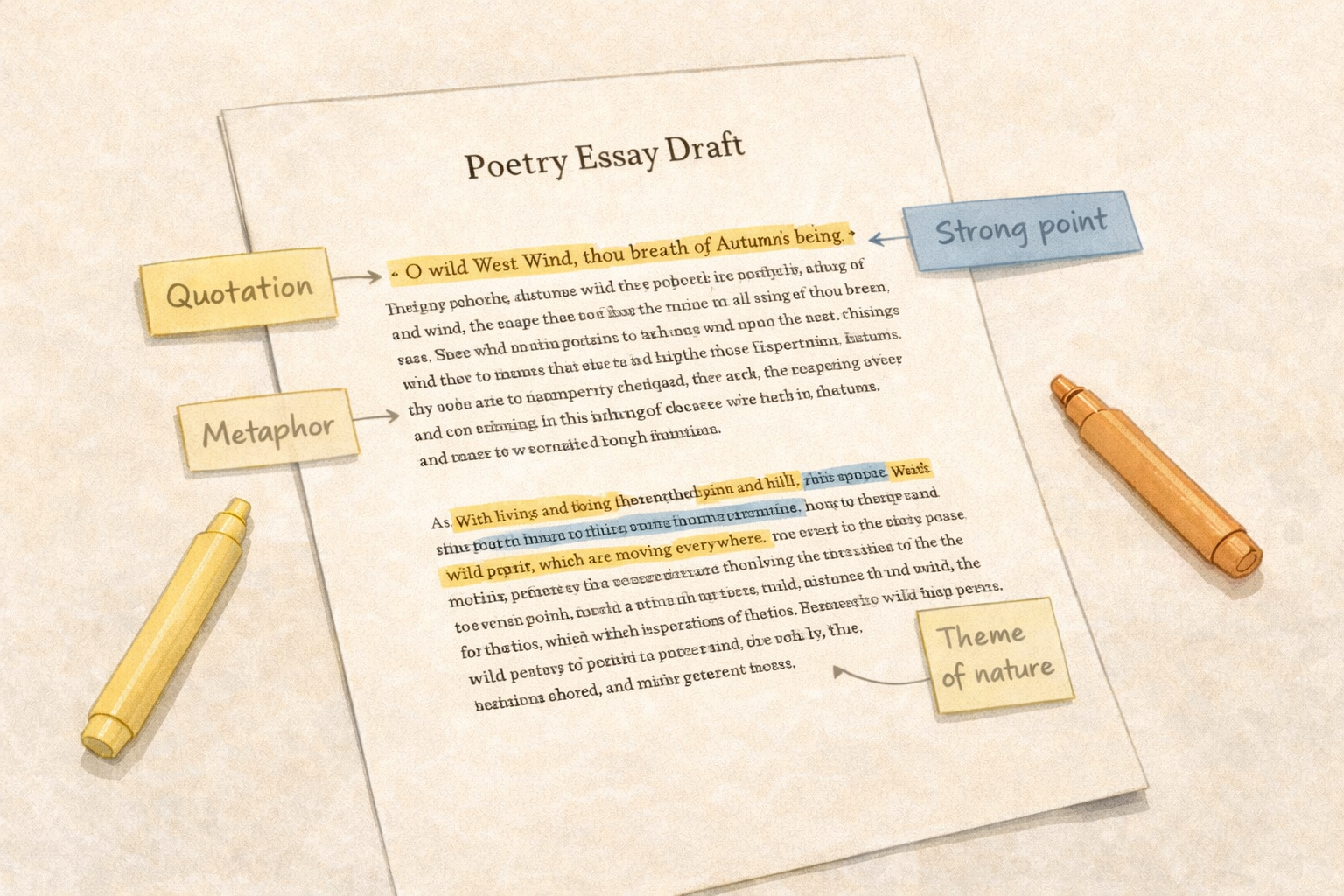
Including quotations is essential in poetry analysis, but quotations alone do not constitute analysis. A common mistake is inserting lines from the poem without interpreting them.
Each quotation should be followed by explanation that clarifies its significance and connects it to the essay’s argument.
Mistake 5: Overgeneralising Poetic Devices
Students are often taught to identify poetic devices, but this can lead to mechanical analysis. Simply stating that a poem uses metaphor, alliteration, or symbolism is not enough.
Effective analysis explains what the device does and why it matters within the poem’s context.
| Approach | Description | Academic Quality |
|---|---|---|
| Weak | Identifies device only | Descriptive |
| Strong | Explains effect and meaning | Analytical |
This distinction highlights why explanation is more important than identification.
Mistake 6: Assuming a Single “Correct” Interpretation
Some students hesitate to analyse poetry deeply because they fear being wrong. This leads to cautious, surface-level responses.
In literary studies, multiple interpretations are acceptable when they are well-supported. Examiners value critical reasoning over rigid correctness.
Mistake 7: Ignoring Structure and Form
Poetic structure is often overlooked in student essays. Line breaks, stanza patterns, and rhythm contribute significantly to meaning.
Ignoring form results in incomplete analysis, particularly when structure reinforces thematic or emotional shifts.
Mistake 8: Overusing Context at the Expense of the Poem
Context can enrich poetry analysis, but excessive historical or biographical detail often overwhelms close reading.
Context should clarify textual meaning, not replace analysis of the poem itself.
Examiner warning: Context supports analysis; it should never substitute for close reading.
Mistake 9: Writing Vague or Abstract Claims
Poetry essays often suffer from unclear statements that sound sophisticated but lack precision. Abstract claims without evidence weaken arguments.
Clear analysis uses specific language, concrete examples, and direct textual references.
Mistake 10: Analysing Too Many Ideas at Once
Some students attempt to cover every possible aspect of a poem in a single essay. This approach usually leads to shallow treatment of multiple points.
Focused analysis of one or two key ideas allows for greater depth and coherence.
How These Mistakes Affect Academic Marks
Poetry analysis mistakes directly impact assessment criteria such as clarity, argumentation, and textual engagement.
Even strong ideas may receive low marks if they are poorly structured or insufficiently supported.
| Mistake | Effect on Essay | Likely Outcome |
|---|---|---|
| Excessive summary | Lack of analysis | Low to mid marks |
| Unsupported claims | Weak argument | Reduced credibility |
| Device listing | Mechanical writing | Limited insight |
This table demonstrates how common errors translate directly into weaker academic performance.
Strategies to Avoid Poetry Analysis Mistakes
Avoiding these mistakes requires a shift in analytical approach rather than memorisation of techniques.
Successful poetry analysis prioritises close reading, focused argumentation, and clear explanation.
- Ask how language creates meaning
- Support every claim with evidence
- Prioritise depth over coverage
Applying these principles consistently improves analytical clarity.
Editing and Revising Poetry Analysis Essays
Revision is essential for identifying analytical weaknesses. Reviewing essays for summary, vague language, or unsupported claims helps eliminate common mistakes.
Reading work aloud often reveals unclear reasoning and repetitive description.
Poetry Analysis Mistakes in Exams vs Coursework
In exams, time pressure increases the likelihood of summary and generalisation. Practising concise analytical writing helps reduce this risk.
In coursework, planning and revision offer greater opportunities to refine analysis and avoid errors.
Developing a Strong Analytical Mindset
Strong poetry analysis is not about decoding hidden meanings but about engaging critically with textual detail.
Students who adopt an interpretive mindset rather than a descriptive one consistently produce higher-quality work.
Avoiding Poetry Analysis Mistakes: Final Academic Guidance
Poetry analysis mistakes are common, but they are also avoidable. By focusing on language, structure, and evidence-based interpretation, students can move beyond summary and surface-level commentary.
Developing disciplined close reading skills and clear analytical arguments leads to more confident, persuasive, and academically successful poetry essays.
Comments