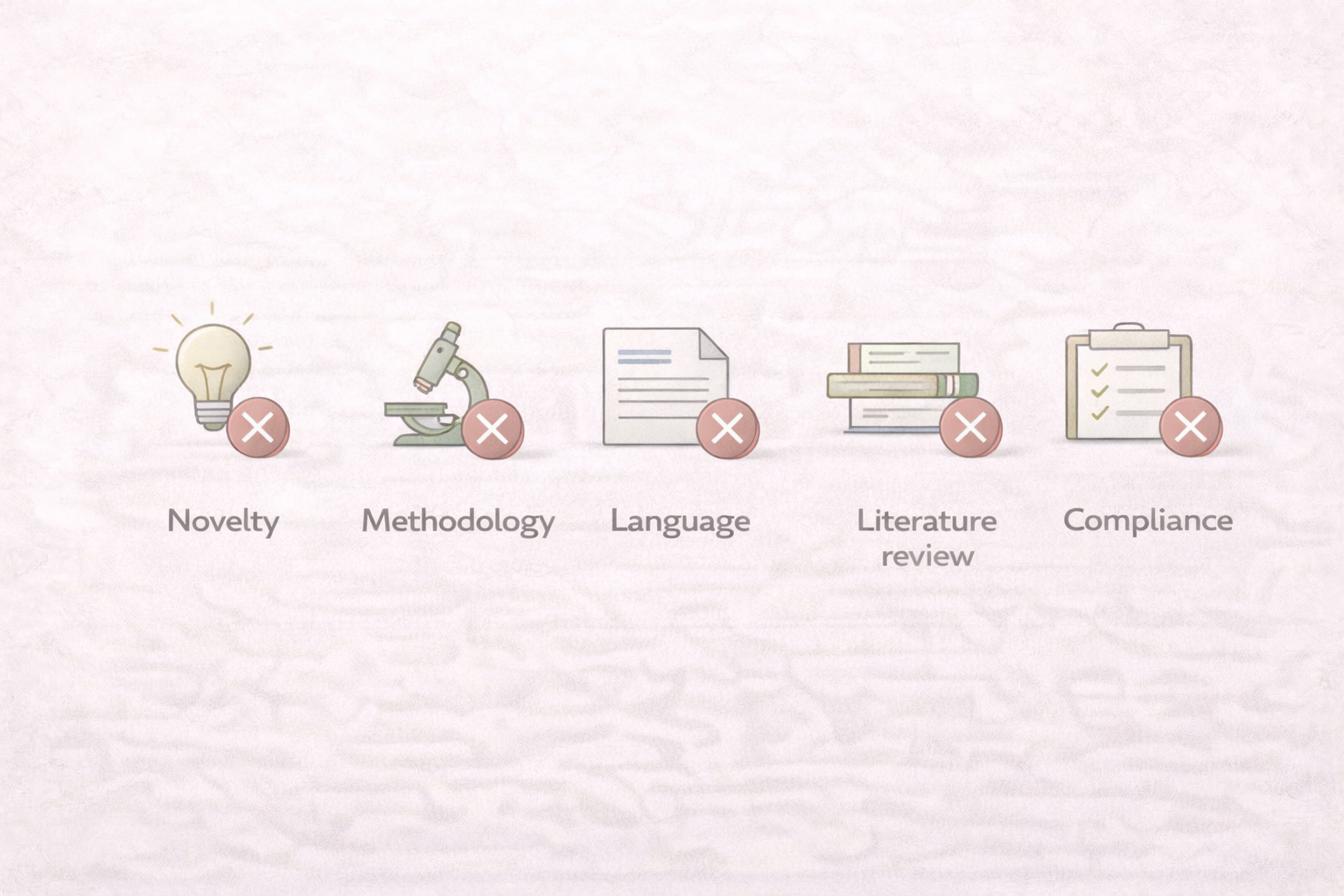
Rejection from Scopus Q1–Q2 journals is rarely random. Editors working at the highest journal quartiles apply consistent screening criteria designed to protect scholarly credibility, reviewer time, and journal reputation. For university students, PhD candidates, and early-career researchers, the most frustrating rejections are not caused by lack of effort, but by structural, methodological, and reporting errors that signal “not publication-ready.” Understanding the top reasons authors fail submissions to Scopus Q1–Q2 journals is therefore a critical academic skill, not merely a publishing concern.
This article analyses the five most common rejection triggers shown in the image—lack of novelty, weak methodology, poor academic English, insufficient literature review, and ignoring formal requirements—and explains why each one matters to editors. Each section also shows what typically goes wrong in student manuscripts and how to correct the issue before submission. Where relevant, it links to specific Epic Essay resources that strengthen the underlying academic skills journals expect.

Why Scopus Q1–Q2 journals reject so aggressively
High-quartile journals operate under extreme selectivity. Acceptance rates are often below 10%, and many submissions are rejected at the desk-review stage without external peer review. This is not hostility toward new authors; it is a structural necessity. Editors must prioritise manuscripts that clearly demonstrate novelty, methodological credibility, disciplinary relevance, and compliance with technical standards. Anything that increases uncertainty or reviewer burden is filtered out early.
For students transitioning from coursework or dissertations to journal submissions, the key adjustment is recognising that “good for assessment” is not the same as “ready for publication.” Coursework rewards engagement and learning; journals reward contribution, precision, and reproducibility. Editors therefore read submissions defensively, looking for reasons not to proceed. The five reasons below account for the majority of early rejections.
In Q1–Q2 journals, editors do not ask “Is this interesting?” first. They ask “Is this trustworthy, novel, and reviewable?”
1. No real scientific novelty (“novelty or nothing”)
The number one reason manuscripts are rejected by Scopus Q1–Q2 journals is lack of genuine novelty. Editors quickly recognise when a paper repackages existing knowledge with new wording, applies a standard method to a well-studied problem without justification, or repeats findings already established in the literature. Even strong execution cannot compensate for absence of contribution at this level.
Novelty does not mean inventing a new topic. It means making a defensible addition to what is already known: refining a theory, extending evidence to a new context that challenges assumptions, introducing a more robust method, or resolving a documented gap or inconsistency. Students often fail here because their research questions are too broad or descriptive. If you struggle to articulate what your study adds, use What Makes a Research Question Publishable? Key Criteria Explained to test whether your question supports a publishable contribution.
What typically goes wrong is that authors claim novelty rhetorically (“this is the first study to…”) without evidential grounding. Editors treat unsupported novelty claims as red flags. A stronger strategy is to demonstrate novelty implicitly by positioning your study against recent, high-impact literature and showing precisely what changes when your findings are considered.
2. Weak or poorly justified methodology
Methodological weakness is the fastest way to lose editor confidence. Scopus Q1–Q2 journals expect robust, reproducible, and valid methodology, not “analysis for the sake of analysis.” Editors immediately reject manuscripts with superficial analyses, unclear sampling logic, underpowered designs, or methods that do not logically answer the research question.
Students frequently describe what they did without explaining why that approach was appropriate. This confusion between methods and methodology undermines credibility. Journals expect authors to justify design choices, acknowledge limitations, and align claims strictly with what the method can support. If your methods section reads like a procedural diary rather than a defensible research strategy, revisit Difference Between Research Methods and Research Methodology Explained for Students.
Another common failure is overstating causal claims based on correlational or descriptive designs. Editors are extremely sensitive to causal language because it implies intervention and policy relevance. If your analysis does not support causality, your language must reflect that. To discipline claims and protect against methodological rejection, consult Understanding Causal Inference in Academic Research.
3. Poor academic English and clarity
Contrary to popular belief, Q1–Q2 journals do reject manuscripts solely for language quality. Poor academic English obscures argument logic, introduces ambiguity, and significantly increases reviewer workload. Editors must ensure that peer reviewers can evaluate substance without being distracted by unclear phrasing or grammatical breakdowns.
Importantly, “poor English” does not mean non-native English. It means unclear academic writing: inconsistent terminology, long unstructured sentences, vague claims, and imprecise verbs. Students often assume reviewers will “read past” language issues, but at Q1–Q2 level, clarity is a baseline requirement, not a bonus.
Language problems become especially damaging when they affect the abstract, methods, or results sections, because these are used by editors to decide whether the paper is reviewable at all. Before submission, manuscripts should undergo focused academic editing, not casual proofreading. For high-stakes submissions, formal support such as Academic Editing and Proofreading can prevent desk rejection based on avoidable language issues.
4. Insufficient or outdated literature review
An insufficient literature review signals immediately that a manuscript is not ready for a Scopus Q1–Q2 journal. Editors expect engagement with recent, high-quality sources, typically 40–50 or more references for empirical papers, with a strong emphasis on work published in the last three to five years. Fifteen references—even if well written—are rarely enough.
The deeper issue is not number, but function. A Q1–Q2 literature review must do analytical work: establish what is known, identify where evidence is weak or contradictory, and justify why the present study is necessary. Students often summarise sources instead of synthesising them, producing a background section that lacks argumentative force. If your review does not clearly build toward a gap, your paper has little chance of survival.
Strong literature reviews are structurally organised, not chronological. They group sources around debates, methods, or theoretical tensions. If you are unsure how to structure synthesis effectively, Essay Structure Explained for University Students provides transferable logic that applies equally to journal manuscripts.
5. Ignoring formal and technical journal requirements
Many authors underestimate how often manuscripts are rejected for technical non-compliance. Scopus Q1–Q2 journals enforce strict requirements on cover letters, author contributions, conflict-of-interest declarations, ethical approval statements, reference style, table formatting, and figure quality. Even small deviations can trigger automatic rejection.
From an editorial perspective, failure to follow instructions signals either inexperience or lack of care—both risks at high-impact levels. Editors cannot afford to shepherd authors through basic compliance issues. Students transitioning from coursework often neglect these components because they are not emphasised in assessment, but in publishing they are non-negotiable.
Common mistakes include missing ethics statements, inconsistent reference styles, poorly formatted tables, and unreferenced appendices. If your manuscript includes supplementary material, it must be clearly referenced and professionally formatted. For guidance on structuring supporting materials, see Report With Appendices: Formatting Rules for Academic Submissions.
| Rejection reason | What editors infer | What authors should fix before submission |
|---|---|---|
| No clear novelty | The paper does not advance knowledge beyond existing studies | Refine the research question and explicitly position contribution against recent literature |
| Weak methodology | Findings may be unreliable or misinterpreted | Justify design choices and align claims strictly with methodological limits |
| Poor academic English | Reviewers will struggle to assess the paper accurately | Edit for clarity, precision, and consistency before submission |
| Insufficient literature review | The author lacks awareness of current debates | Expand and synthesise recent, high-quality sources |
| Technical non-compliance | The author did not follow journal instructions | Audit submission requirements line by line |
Table 1 should be used as a pre-submission diagnostic. If any row describes your manuscript, revision is required before submission to a Q1–Q2 outlet.
How students and early-career researchers can reduce rejection risk
Reducing rejection risk is less about “writing better” and more about aligning your work with journal logic. This means planning for publication early, choosing research questions with contribution potential, designing methods that support defensible claims, and writing with clarity and precision. It also means treating journal instructions as part of the research process, not an administrative afterthought.
For students working on dissertations or research projects with publication ambitions, structured guidance can help bridge the gap between assessment writing and journal writing. Resources such as Dissertations & Research Papers outline research workflows that prioritise publishability rather than last-minute adaptation.
A publication-ready mindset for Scopus Q1–Q2 journals
The core lesson from editor rejection patterns is clear: Scopus Q1–Q2 journals reward precision, credibility, and contribution. They do not reward effort, ambition, or topic popularity on their own. Most rejections are preventable if authors understand what editors are screening for and address those criteria systematically.
Before submitting, ask whether your manuscript makes a clear contribution, uses a defensible method, communicates with academic clarity, engages deeply with recent literature, and complies fully with journal requirements. If the answer is “not yet,” revision is not failure—it is part of the publication process. Developing this mindset early is one of the most valuable academic skills a researcher can acquire.

Comments