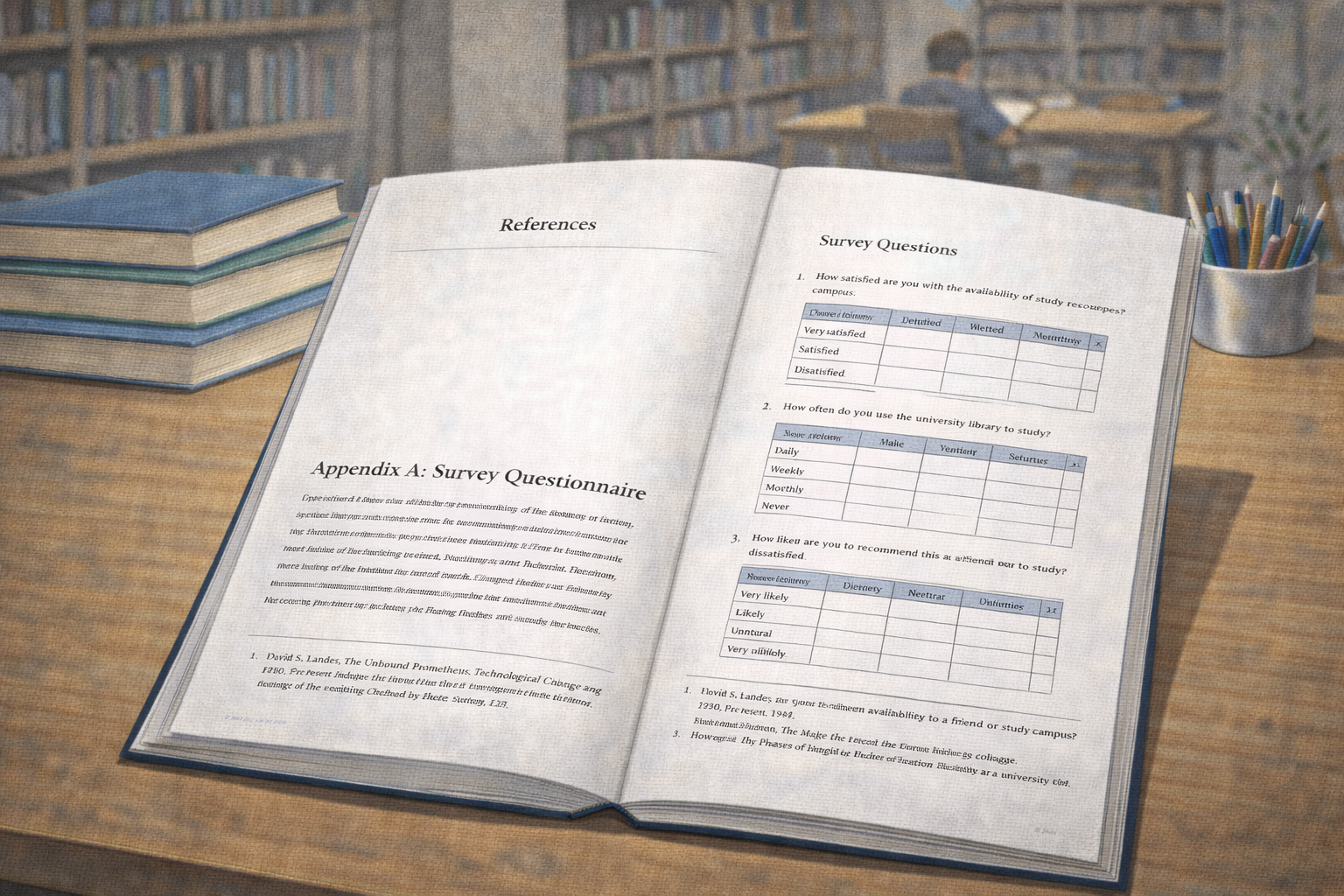
An appendix is a fundamental component of many academic reports but remains one of the most misunderstood sections for students entering higher education. In report writing, clarity and precision are paramount: the main text must deliver arguments and findings with logical flow and readability. Supplementary content that supports the analysis — such as raw data, extended results, questionnaires, or technical material — often cannot be integrated into the main narrative without disrupting coherence. An appendix resolves this tension by housing such material separately while ensuring transparency and academic rigour. :contentReference[oaicite:0]{index=0}
This article clarifies what an appendix in a report is, the kinds of content that belong there, how to structure and label it, and common mistakes to avoid. It draws on established academic conventions that align with university assessment standards, with specific guidance that helps students produce professional-quality reports that meet examiner expectations. Along the way, we will link to related academic writing resources to deepen understanding where appropriate.
Defining an Appendix in a Report
In the context of academic reports, an appendix is a supplemental section placed after the main body and reference list. It contains material that enhances the report’s transparency and completeness but is not essential for the reader’s immediate understanding of the argument or findings. The key criterion is relevance without intrusion: appendix content should support claims made in the report without interrupting the main narrative flow. :contentReference[oaicite:1]{index=1}
This definition sets an important academic boundary. An appendix helps maintain readability by relocating detailed material — such as raw data tables or survey instruments — that would otherwise clutter the report’s core sections. It is not a repository for weak arguments or raw evidence that ought to be interpreted within the analysis. Students who misuse appendices to bypass word counts or hide undeveloped points risk undermining the academic quality of their work.
Academic rule: An appendix in a report supports the main text but does not replace core analysis or interpretation. :contentReference[oaicite:2]{index=2}
When Appendices Are Appropriate in Academic Reports
Not every report requires an appendix. Typically, appendices are appropriate when the material is directly relevant to the report but too lengthy, detailed, or technical for inclusion within the main chapter structure. This is particularly common in:
- Research reports involving large datasets or statistical outputs
- Fieldwork or empirical studies that produce extensive documentation
- Technical protocols or procedural descriptions required for reproducibility
- Survey research that includes full questionnaires or interview schedules
For example, in a business research report that uses surveys, the full questionnaire might be placed in Appendix A, while detailed demographic tables might sit in Appendix B. This preserves the main text’s analytical clarity while giving readers access to the complete instruments used. :contentReference[oaicite:3]{index=3}
By contrast, appendices are unnecessary when all evidence and explanation can be integrated smoothly into the main text without exceeding word limits or disrupting reader comprehension. In short, students should include an appendix only when it serves a clear academic purpose.
Types of Material Suitable for Report Appendices
Below is a structured overview of common appendix content and its role in supporting academic reports. This table differentiates between material that belongs in the appendix versus what should remain in the main body of the report.
| Material Type | Main Text | Appendix |
|---|---|---|
| Core analysis and interpretation | ✔ | ✘ |
| Extended raw data tables | ✘ | ✔ |
| Survey or research instruments | ✘ | ✔ |
| Statistical output (full results) | ✘ | ✔ |
| Methodological protocols | ✘ | ✔ |
| Descriptive narrative or findings synthesis | ✔ | ✘ |
This table helps students decide where to place specific content. Core interpretation and synthesis belong in the main text, while supplementary evidence — if referenced — belongs in the appendix. :contentReference[oaicite:4]{index=4}
Organising and Labelling Appendices Correctly
Effective organisation is essential for appendix clarity. Each appendix should:
- Begin on a new page
- Have a clear, descriptive title that reflects its content (e.g., “Appendix A: Survey Questionnaire”)
- Be labelled alphabetically when more than one appendix is used
Alphabetical labelling (Appendix A, Appendix B, etc.) is the standard in many universities, though numerical systems may be permitted in some disciplines. Importantly, consistent labelling helps examiners locate and interpret appendix material efficiently. Each appendix should contain only one category of content to avoid confusion. :contentReference[oaicite:5]{index=5}
Referencing Appendices in the Report Text
An appendix has no academic function unless it is clearly referenced in the main body of the report. Every piece of supplementary material must be signposted at the point where it becomes relevant to the discussion. Vague references such as “see appendix” without context should be avoided.
Examiner expectation: Each appendix must be explicitly referenced in the main text with clear explanation of its purpose. :contentReference[oaicite:6]{index=6}
A clear reference example might read: “Full survey questions are provided in Appendix A,” signalling to the examiner why the appendix exists and where to find relevant material. Without such references, even relevant content may be ignored or deemed irrelevant.
Common Mistakes Students Make with Report Appendices
Despite their apparent simplicity, appendices are frequently misused. Common errors include:
- Including core argument elements in the appendix to circumvent word limits
- Failing to reference appendices in the main text
- Overloading appendices with irrelevant material
- Inconsistent labelling or unclear titles
These mistakes often stem from misunderstanding the appendix’s purpose. Remember that appendices serve to support — not replace — well-developed main text arguments.
Academic Strategies for Using Appendices Effectively
Using appendices strategically involves careful selection and disciplined restraint. Before adding an appendix, ask:
- Is this material referenced in the main report?
- Does the appendix content strengthen transparency or provide necessary evidence?
- Could the material be integrated into the main body without disrupting flow?
If the answer to the first two questions is yes and to the third question is no, then an appendix is likely appropriate. This approach ensures that appendices contribute positively to academic quality rather than functioning as an afterthought.
Final Guidance: Balancing Clarity and Completeness in Reports
An appendix in a report is not a miscellaneous appendix space; it is a tool for academic precision. When used correctly, appendices allow writers to balance analytical clarity with evidential completeness. They demonstrate methodological rigour, respect for academic conventions, and professional document organisation. Students who master the strategic use of appendices show advanced academic judgement — an essential skill for success in university and beyond.

Comments