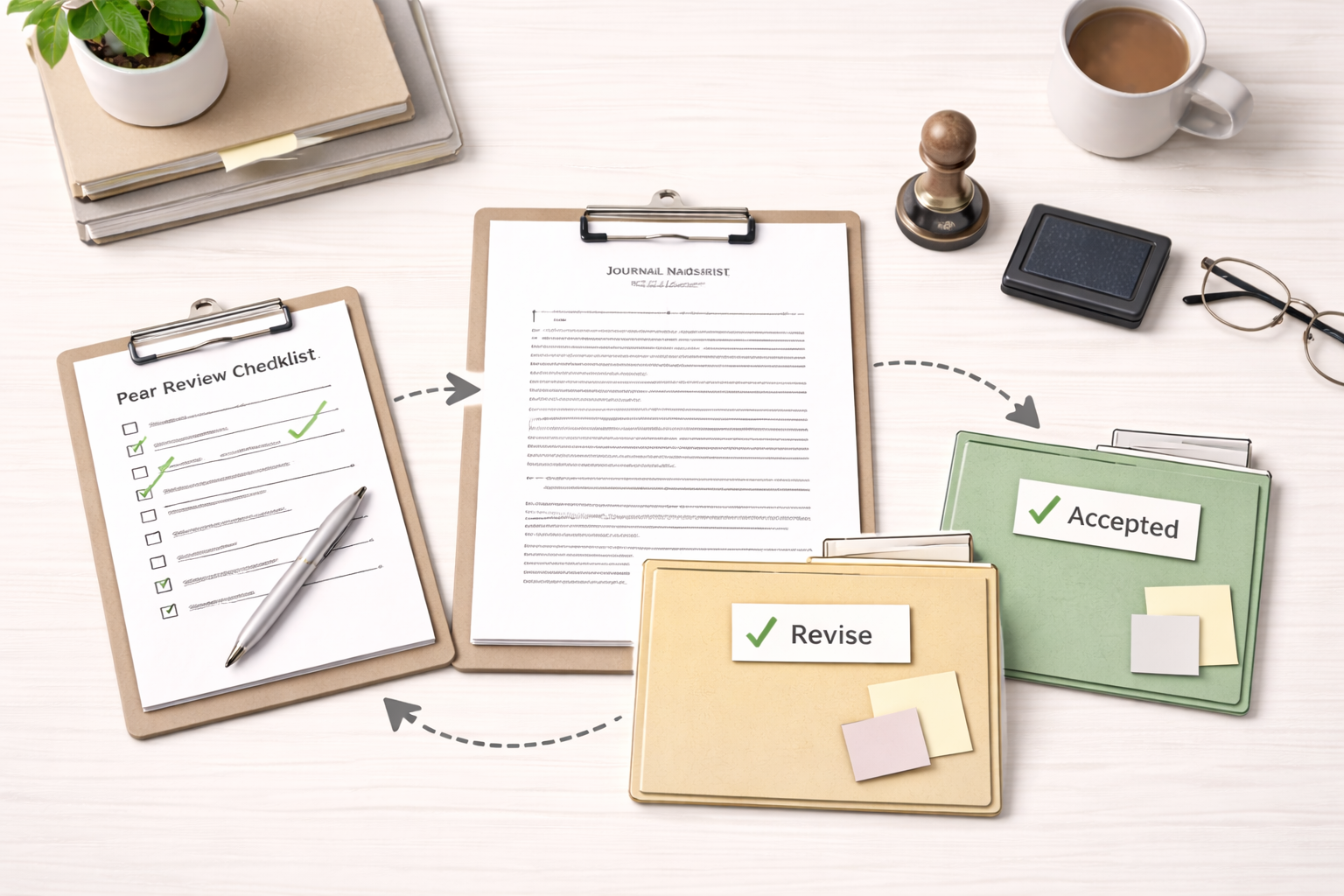
If you are searching for how to get published and asking what journal editors are looking for, the most important shift is to stop treating publication as a writing task and start treating it as an evidence-and-standards task. Editors are not primarily judging how “polished” your prose sounds. They are judging whether your manuscript makes a defensible scholarly contribution, follows discipline-specific reporting norms, and can survive peer review without raising avoidable credibility or ethics concerns. For students and early-career researchers, this is where most preventable rejections occur: strong effort, weak publication readiness.
This article translates editorial expectations into concrete, assessable components: contribution, scope fit, methodological transparency, reporting standards, ethical compliance, and editorial practicality. It also shows how common university writing habits—such as broad research questions, unclear methods, or overconfident causal claims—become publication liabilities. Where relevant, you can deepen key research-writing skills using Epic Essay guides on publication-ready research questions, methods vs methodology, and causal inference.

What “editors are looking for” really means in academic publishing
Editorial evaluation is a triage system. Most journals receive far more submissions than they can publish, so editors prioritise manuscripts that are clearly within scope, methodologically credible, ethically clean, and communicable to their readership. This is not simply “gatekeeping.” It is a quality-control mechanism that protects the journal’s reputation, indexing value, and reviewer capacity. Many manuscripts fail not because the topic is unimportant, but because the paper cannot be assessed efficiently or trusted under scrutiny.
Editors also work under constraints that students rarely consider: limited reviewer availability, strict publication timelines, and post-publication accountability. This is why editors value transparency and reporting discipline. When a manuscript is hard to evaluate—because aims are vague, methods are underspecified, or results are selectively presented—reviewers are less willing to take it on, and editors are more likely to reject quickly. In practice, “publishable” often means “reviewable without guessing.”
A publishable manuscript is not merely interesting; it is assessable, reproducible or auditable, ethically defensible, and clearly situated in a scholarly conversation.
Contribution and novelty: how editors judge whether your paper is worth review
Editors rarely look for novelty in the sense of “nobody has ever studied this before.” They look for a contribution that is legible and meaningful to the journal’s audience. Contribution can mean a new finding, a stronger method applied to an old question, a replication that changes confidence in a claim, a new dataset, a theoretical integration, or a context shift that challenges generalisability. What matters is that the manuscript clearly states what is added and why it matters beyond the local case.
The most common student-level failure here is an under-specified research question. Papers that ask “broad topic questions” often drift into background narrative and cannot justify why the study exists. Editors prefer questions that are feasible, specific, and anchored in a real gap. If you want a concrete standard for shaping your manuscript’s “so what,” use What Makes a Research Question Publishable? to refine clarity, feasibility, and disciplinary significance before you draft the introduction.
Another frequent error is confusing topical popularity with publication significance. A fashionable theme does not compensate for weak framing. Editors want a tight statement of the problem, a precise gap, and an explicit claim about what your paper changes in the literature. This is why strong introductions behave like arguments, not like general overviews; if you need an academic structure for that, revisit How to Write an Essay Introduction and translate the same logic into your journal-style opening.
Scope and fit: why strong papers still get rejected
Scope mismatch is one of the fastest routes to desk rejection. Editors select papers that serve their journal’s specific readership, methodological norms, and topical priorities. A technically strong manuscript can still be a poor fit if it frames the contribution in the wrong conversation or uses an approach the journal does not publish. This is not a judgment of your ability; it is a judgment of alignment.
Fit is also rhetorical. Editors want to see that you know where you are publishing: the manuscript should cite relevant work commonly published in that journal or adjacent journals, position itself within the journal’s themes, and follow the journal’s submission rules. When authors submit a generic manuscript to multiple outlets without tailoring the framing, editors detect it quickly. A small but meaningful practice is rewriting the abstract and introduction paragraph that signals relevance to the journal’s audience.
| Fit signal in the manuscript | What the editor infers | How to strengthen it in revision |
|---|---|---|
| The paper cites recent, relevant work commonly published in the target journal’s area | The author understands the journal’s ongoing scholarly conversation and audience needs | Update the introduction and literature review to engage the journal’s typical debates, not only your local course readings |
| The research question is framed in a way the journal typically publishes | The study is likely to interest reviewers and readers who follow this outlet | Reframe the question using a clear gap-and-contribution logic; ensure feasibility and specificity |
| The reporting style matches disciplinary norms (structured abstracts, reporting checklists, etc.) | The manuscript will be reviewable and comparable to existing published studies | Adopt the appropriate reporting guideline (for example, PRISMA for systematic reviews or CONSORT for trials) where relevant |
Table 1 highlights an uncomfortable truth: “fit” is partly about scholarly belonging. You improve fit by positioning your work correctly, not by adding filler citations.
Methodological credibility: the fastest way to lose editor confidence
Editors and reviewers treat methods as the foundation of trust. If your methods are unclear, your results become hard to interpret; if your methods are weak, your conclusions become risky; if your methods are inconsistent with your question, your study becomes incoherent. This is why many journals evaluate methodology and reporting quality before they evaluate writing style. Even in qualitative or theoretical papers, the methodological logic must be explicit and defensible.
Students often confuse “methods” (what you did) with “methodology” (why that approach makes sense, and what epistemological or design logic supports it). This confusion produces submissions that list instruments and procedures but do not justify choices. If you want a clean academic distinction that strengthens your Method section and reduces reviewer objections, use Difference Between Research Methods and Research Methodology and ensure your manuscript explains both the operational steps and the strategic reasoning.
Another credibility risk is overclaiming causality. Editors are cautious about causal language because it implies responsibility and intervention effectiveness. If your design is correlational, reviewers will flag causal verbs (“causes,” “leads to,” “results in”) as methodological errors. Strengthen your claims by aligning language to design and by explicitly addressing confounding and comparison logic; Understanding Causal Inference provides a practical way to discipline causal claims.
Reporting standards: why journals care about checklists and structure
Reporting standards exist because many published studies historically lacked the information needed for replication, appraisal, or synthesis. Journals increasingly rely on structured reporting guidelines to ensure that critical details are present. This does not mean every paper must follow the same format, but it does mean that omissions are treated as quality risks rather than stylistic choices. For example, systematic reviews are commonly expected to report selection logic clearly, and clinical trials are expected to report allocation and outcomes transparently.
As a general principle, the more your manuscript makes strong empirical claims, the more transparent it needs to be. A helpful starting point is the EQUATOR Network, which hosts reporting guidelines for different study types. If your target journal requires a particular checklist, treat it as a non-negotiable part of submission readiness, not as an optional appendix.
- Use reporting guidance that matches your study type (for example, PRISMA for systematic reviews, CONSORT for randomised trials, or STROBE for observational studies).
- Ensure the abstract, methods, and results contain the information the guideline expects, not only the supplementary files.
- Write results as evidence linked to pre-specified questions, not as a list of interesting patterns.
This discipline often feels strict to students, but it helps editors protect review time and protect the journal’s credibility.
Ethics and integrity: what triggers immediate editorial concern
Editors routinely screen for ethical red flags because publication can create harm: flawed medical claims, misleading policy conclusions, undisclosed conflicts, or inappropriate data practices. Even in student-to-journal transitions, the ethical bar changes: what passes as “acceptable” in a course report may be insufficient for a public scholarly record. Journals often require explicit statements about ethics approval (where relevant), consent, data handling, funding, conflicts of interest, and authorship contributions.
Integrity problems are not limited to obvious plagiarism. They include self-plagiarism (duplicate publication), salami slicing (unjustified fragmentation of results), undisclosed AI or editing practices where the journal requires disclosure, and citation manipulation. A practical habit is to read the journal’s ethics and authorship policies before submission and align your manuscript components accordingly. For broad ethical expectations, COPE (Committee on Publication Ethics) provides widely referenced guidance for editors and publishers, and the ICMJE Recommendations outline common medical-journal authorship and disclosure standards.
If an editor cannot tell who did what, how data were handled, and what might bias interpretation, the manuscript becomes a reputational risk—even if the topic is strong.
Why papers are desk-rejected: the patterns editors see repeatedly
Desk rejection is usually not a detailed critique; it is a decision that the manuscript is not ready for peer review. Understanding desk-reject patterns helps you focus revision on the issues that matter most. The point is not to fear rejection but to remove avoidable triggers before submission. Many early-career manuscripts are rejected because the editor cannot see a clear contribution quickly enough, or because the methods and reporting are too underdeveloped to justify using reviewer time.
| Common desk-reject reason | What it signals to the editor | How to fix it before submission |
|---|---|---|
| The manuscript is out of scope or framed for the wrong audience | Low likelihood of readership value and reviewer availability | Rewrite the title, abstract, and opening paragraphs to match the journal’s conversation; ensure citations reflect that community |
| The research question is too broad or the contribution is unclear | The study may be descriptive without scholarly payoff | Narrow the question and state a defensible contribution; use publishable question criteria as a revision test |
| Methods are underspecified or do not match the claims | Findings cannot be trusted or evaluated properly | Separate “methods” from “methodology” and justify design choices explicitly; confirm causal language matches design |
| Reporting is incomplete or inconsistent with journal requirements | High editorial burden and high reviewer frustration risk | Adopt the appropriate reporting guideline and ensure key details are in the main text, not only supplementary files |
| Language and presentation obstruct comprehension | Review will be inefficient and error-prone | Revise for clarity and consistency; consider formal editing support such as academic editing and proofreading for high-stakes submissions |
Table 2 is most useful as a pre-submission checklist: if any row describes your manuscript, you should revise before submission rather than “hoping reviewers will be kind.”
Building a submission package editors can assess quickly
Editors do not read your manuscript in isolation. They evaluate a submission package: title, abstract, cover letter, manuscript, declarations, and any supplementary files. A strong package reduces ambiguity and increases reviewer willingness. For students transitioning from coursework writing to journal writing, the most important change is to treat every component as part of an evidence narrative rather than an administrative formality.
Your cover letter should be short, factual, and aligned to the journal: what the paper contributes, why it fits, what type of study it is, and whether it uses recognised reporting guidance. Avoid exaggerated claims about impact. Editors prefer cautious, precise language that matches the evidence and the journal’s scope. If you have not recently done a systematic final check, using a structured review approach like the logic in Essay Writing Checklist for Academic Success can help you catch coherence and presentation issues before submission.
- Confirm scope fit by reading the journal’s aims, recent articles, and submission requirements.
- Rewrite the abstract to match your final results and conclusions, not your early intentions.
- Audit methods for transparency and alignment with your strongest claims.
- Check reporting completeness using the guideline appropriate to your study design.
- Verify ethics, disclosures, and authorship statements match journal policy.
- Do a final clarity and formatting pass so reviewers can focus on substance, not errors.
Notice the logic: you are removing reasons to reject, not attempting to “persuade” editors with style alone.
How to get published with a manuscript that can survive peer review
Publication success is strongly shaped by controllable factors: a publishable question, a defensible design, transparent reporting, ethical clarity, and genuine fit with the journal’s audience. When you align these elements, peer review becomes an improvement process rather than a punishment. When you ignore them, rejection becomes predictable. For students writing dissertations or research papers with publication ambitions, structured support can be helpful at the planning and revision stages; see Dissertations & Research Papers for research-focused academic support and workflow guidance.
The core principle is simple: editors invest reviewer time in manuscripts that are readable, reviewable, and credible. If you build your paper so that your contribution is clear, your methods are defensible, your reporting is complete, and your integrity is visible, you dramatically improve your probability of review—and, over time, publication.
External academic resources editors expect authors to know
Editors often assume authors are aware of standard publication norms and ethics frameworks. The resources below are widely used in editorial policy and are helpful for aligning your manuscript to current scholarly expectations:
- Dennis, A.R. & Gregory, A.T. (2017). How to Get Published: What Are Journal Editors Looking for?
- Committee on Publication Ethics (COPE)
- ICMJE Recommendations for the Conduct, Reporting, Editing, and Publication of Scholarly Work
- EQUATOR Network reporting guidelines (CONSORT, PRISMA, STROBE, and more)
Using these frameworks does not guarantee acceptance, but it does signal scholarly professionalism and reduces avoidable credibility concerns.
Comments